
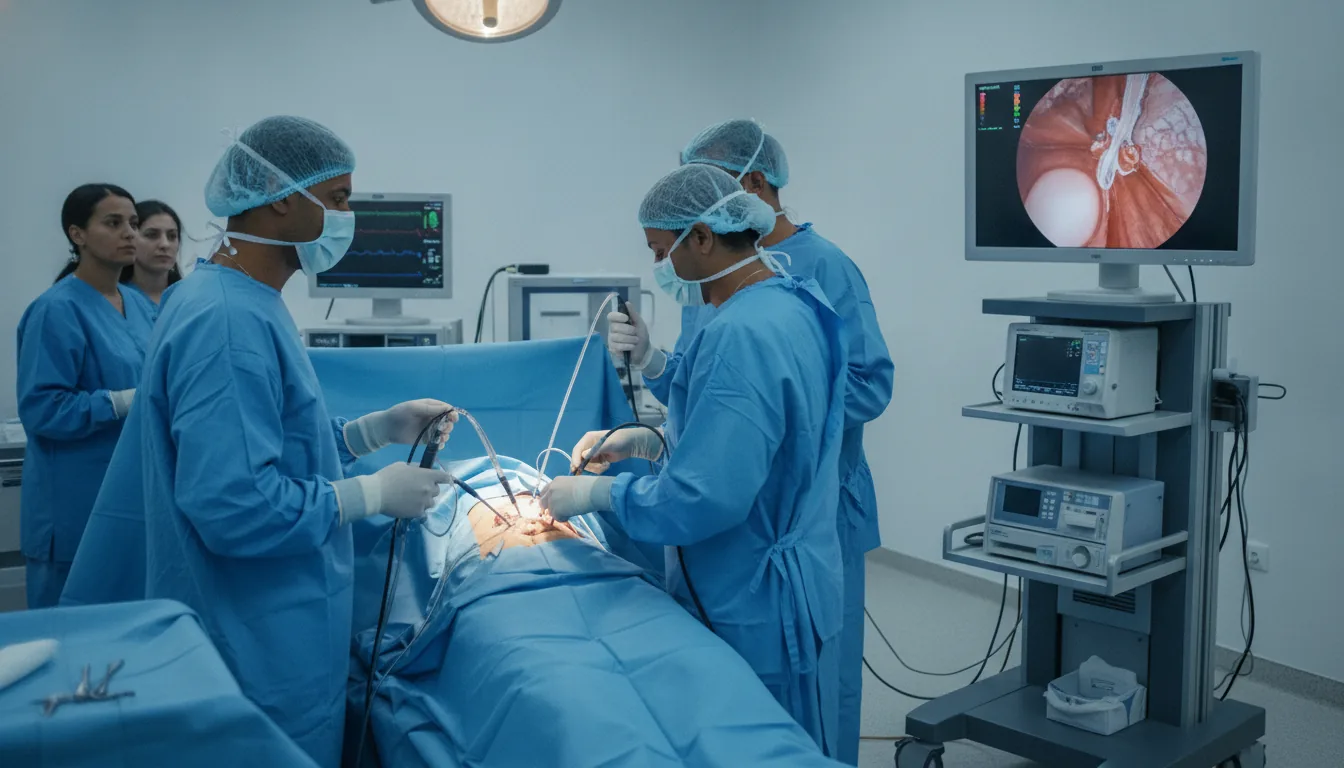
Laparoscopic adrenal gland surgery
Surgeries/Urological/Adrenal gland surgery

Laparoscopic adrenal gland surgery

Minimally invasive removal of a diseased adrenal gland, performed laparoscopically for a simpler postoperative course.

What is it?

The adrenal glands, located above each kidney, produce hormones essential to the body's balance. Certain adrenal tumors — most often benign — can secrete excess hormones or reach a size that justifies their removal: this is adrenalectomy. The laparoscopic approach is today the reference technique for this surgery: through small incisions, the surgeon removes the gland with great precision, under the guidance of a high-definition camera. This minimally invasive approach offers a considerably more comfortable postoperative course than open surgery: less pain, a short hospital stay and rapid recovery. Preparation for the procedure is essential, particularly for hormone-secreting tumors: it is carried out in close collaboration with the endocrinologist and the anesthesia team in order to balance hormone secretion before the surgical procedure. At Clinique Pasteur Tunis, laparoscopic adrenalectomy is performed by surgeons highly experienced in advanced laparoscopy, with a dedicated laparoscopy unit and appropriate postoperative monitoring, in liaison with the endocrinologists.
Laparoscopic adrenal gland surgery

When is it indicated?

Adrenal tumor secreting excess hormones

Certain adrenal tumors produce too many hormones, which disrupts blood pressure, weight or mood. Removing the gland puts an end to this excessive production.

Adrenal tumor of significant size discovered on imaging

Beyond a certain size, an adrenal tumor is removed as a precaution, even without symptoms, to rule out any doubt about its nature.

Suspicious adrenal lesion requiring complete analysis

When imaging cannot confirm that the lesion is benign, its removal allows complete microscopic analysis and removes the uncertainty.

Certain cases of high blood pressure of adrenal origin

High blood pressure that is difficult to control can sometimes stem from a small adrenal tumor. Its removal can normalize blood pressure or significantly reduce the need for medication.

Preparation

1Complete hormonal work-up in collaboration with the endocrinologist
2Precise imaging of the gland (CT scan or MRI)
3Specific medication preparation for certain hormone-secreting tumors
4Mandatory anesthesia consultation
5Fasting for 6 hours before the procedure

Procedure

1

General anesthesia with enhanced monitoring

2

Creation of small incisions for the laparoscopic approach

3

Careful dissection of the adrenal gland and control of its blood vessels

4

Removal of the gland and protected extraction

5

Careful verification, then closure of the small incisions

6

Close monitoring in the recovery room, or even in a step-down unit

Duration

1 hour 30 to 3 hours

Aftercare & Recovery

The hospital stay generally lasts a few days. Hormonal balance is checked after the procedure, and temporary replacement therapy may be necessary in some cases, supervised by the endocrinologist. Recovery is rapid thanks to the minimally invasive approach.

Risks and side effects

Intraoperative blood pressure fluctuations, anticipated by medical preparation
Bleeding, controlled by the laparoscopic technique and the team's experience
Temporary hormonal imbalance, corrected with appropriate treatment

These risks remain rare. Your surgeon will inform you in detail before the procedure.

Request a Quote

Contact us to schedule a consultation or receive a personalized quote.

Request a Quote +216 36 402 000

At a glance

Duration: 1 hour 30 to 3 hours
Preparation: Required
Dedicated specialist team