
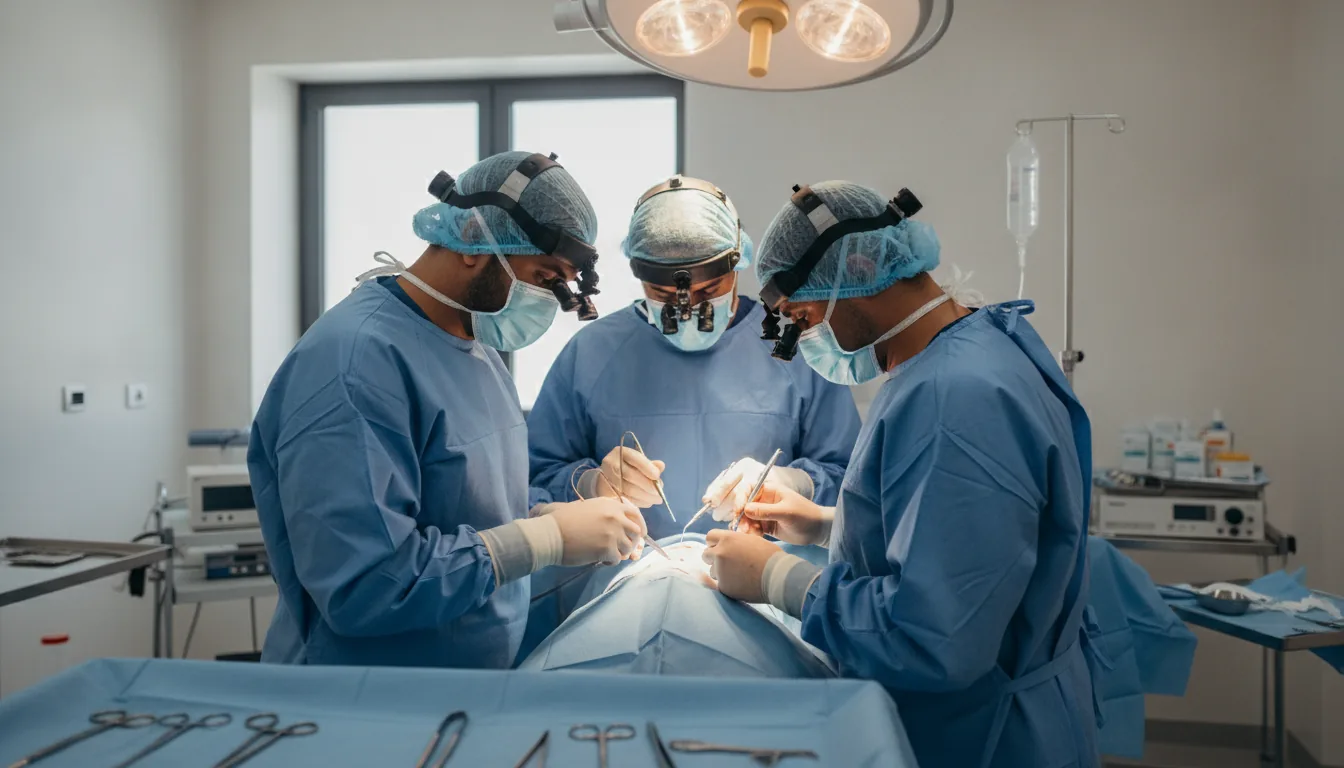
Surgery for urogenital malformations
Surgeries/Urological/Urogenital malformations

Surgery for urogenital malformations

Surgical correction of congenital abnormalities of the urinary and genital tract, in children as well as adults.

What is it?

Certain abnormalities of the urinary or genital tract are present from birth: abnormal position of the urinary opening (hypospadias), reflux of urine from the bladder to the kidney, narrowing of the junction between the kidney and the ureter, undescended testicle, or rarer malformations. Others are discovered later, in adulthood. Surgery for urogenital malformations aims to restore normal anatomy and function: protecting the kidney, allowing comfortable urination, preserving future fertility and cosmetic appearance. The techniques used are tailored to each malformation and, whenever possible, minimally invasive. These procedures require particular expertise, careful planning based on imaging and clear information for patients and families, especially when children are involved. At Clinique Pasteur Tunis, these procedures are performed by experienced urologists, in collaboration with the pediatric surgery team when the patient is a child, in a suitable and reassuring environment.
Surgery for urogenital malformations

When is it indicated?

Hypospadias and abnormalities of the urinary opening

When the urinary opening is not normally positioned at birth, reconstructive surgery restores normal anatomy and urination, with a refined cosmetic result.

Symptomatic vesicoureteral reflux

When urine flows back abnormally from the bladder to the kidney and causes repeated infections, surgical correction protects the kidney for the future.

Ureteropelvic junction syndrome (narrowing between kidney and ureter)

A passage that is too narrow at the outlet of the kidney obstructs the flow of urine and causes the kidney to dilate. The procedure widens this passage and preserves kidney function.

Undescended testicle

When a testicle has not descended spontaneously into the scrotum, surgery repositions it in order to protect its future function and make monitoring easier.

Other malformations of the urinary or genital tract requiring correction

Each malformation is unique: the procedure is tailored case by case, with the goals of normal function, preservation of fertility and a good cosmetic result.

Preparation

1Precise imaging work-up (ultrasound, sometimes CT scan or scintigraphy)
2Urine analysis to rule out infection
3Anesthesia consultation, adapted to the patient's age
4Fasting according to the anesthesia team's instructions

Procedure

1

General anesthesia

2

Surgical correction of the malformation using the appropriate technique

3

Use of minimally invasive techniques whenever possible

4

Possible placement of a temporary catheter or drain

5

Postoperative monitoring adapted to the patient's age and the type of procedure

Duration

1 to 3 hours depending on the malformation

Aftercare & Recovery

Recovery depends on the type of correction performed. Regular follow-up is organized to verify a good anatomical and functional result, particularly in children, whose growth is taken into account in the monitoring schedule.

Risks and side effects

Temporary local discomfort or swelling
Urinary tract infection, prevented by preoperative checks
An additional procedure is sometimes needed later on, explained beforehand by the surgeon

These risks remain rare. Your surgeon will inform you in detail before the procedure.

Request a Quote

Contact us to schedule a consultation or receive a personalized quote.

Request a Quote +216 36 402 000

At a glance

Duration: 1 to 3 hours depending on the malformation
Preparation: Required
Dedicated specialist team