
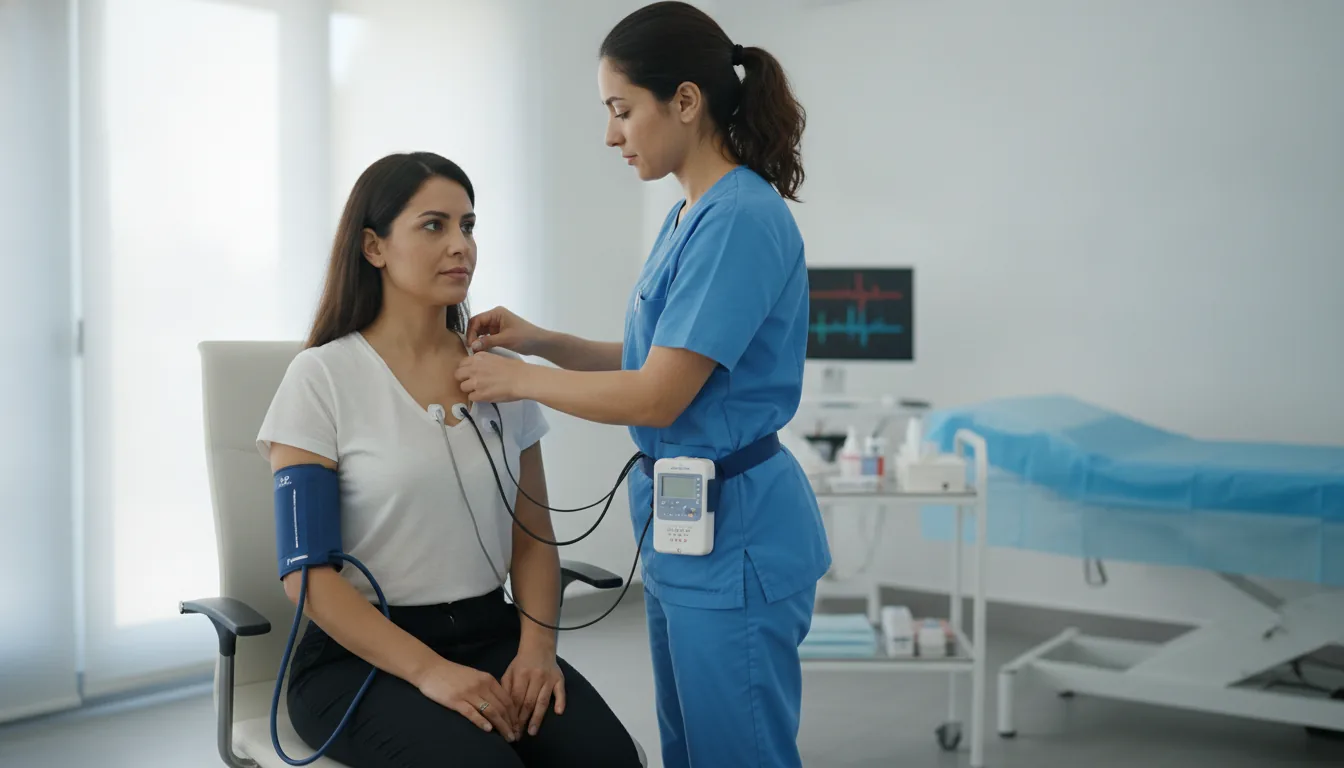
Holter ECG and blood pressure monitoring
Continuous recording of the heart rhythm or blood pressure over 24 to 48 hours, in the patient's real-life conditions.
What is it?
When is it indicated?
When these symptoms occur in unpredictable episodes, prolonged recording during daily life captures what a one-off consultation cannot see.
Some arrhythmias come and go without warning; by monitoring the heart day and night, the Holter maximises the chances of recording them the moment they occur.
While on treatment for a rhythm disorder, continuous recording verifies that episodes have indeed decreased and that the rhythm remains regular throughout the day.
Repeated blood pressure measurements in real-life conditions confirm or rule out hypertension and help fine-tune treatment when blood pressure is resistant.
Blood pressure should normally drop during sleep; only a night-time recording can verify this behaviour, which is important for heart health.
Preparation
Procedure
Placement of the electrodes on the chest or the blood pressure cuff on the arm
Start-up of the recorder worn on a belt or shoulder strap
Return home and continuation of normal daily activities
Continuous recording for 24 to 48 hours
Removal of the device at the clinic and analysis of the data by the cardiologist
Duration
Fitting in a few minutes, recording over 24 to 48 hours
Results
After analysing the recording, the cardiologist provides a detailed report that identifies any rhythm disorders or blood pressure abnormalities and guides the next steps in care.
Risks and side effects
These risks remain rare. Your physician will inform you in detail before the examination.
Book an Appointment
Contact us to schedule your examination or request a quote.
Request a Quote +216 36 402 000