
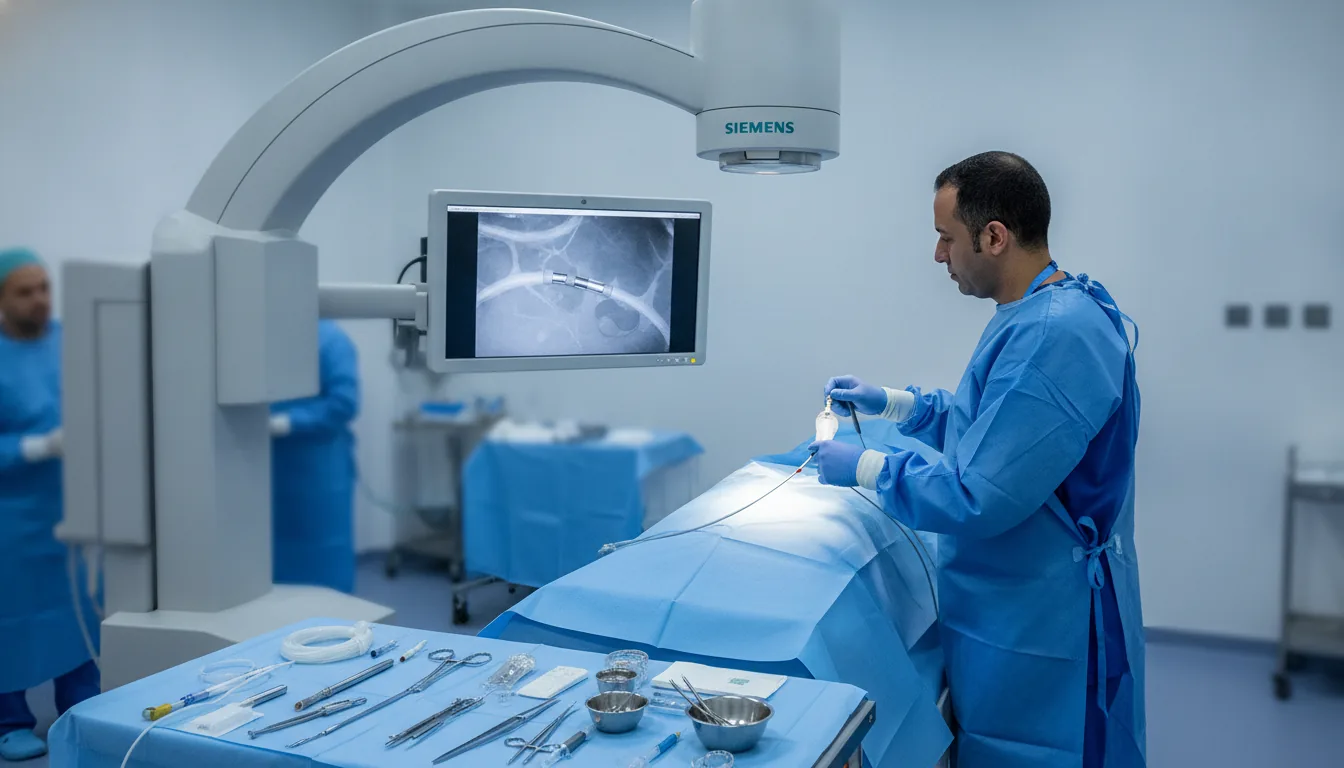
Coronary angioplasty with stent placement
Percutaneous procedure to widen a coronary artery narrowed by atherosclerosis and place a stent (a small metal mesh tube) to keep the artery open.
What is it?
When is it indicated?
In the event of a heart attack, quickly reopening the artery responsible and placing a stent is the standard treatment: every minute gained preserves heart muscle.
When a proven arterial narrowing causes exertional pain, angioplasty restores good blood flow and makes the symptoms disappear.
If medications are no longer enough to relieve the pain caused by a severely narrowed artery, mechanically opening the vessel becomes the most effective solution.
A stent that has already been placed can sometimes narrow again over time; a new procedure then restores blood flow.
When several arteries are affected, a team of cardiologists and surgeons reviews each case to choose between stents and bypass surgery, whichever solution is most suitable.
Narrowing of this main artery of the heart can, in certain carefully selected cases, be treated by angioplasty rather than surgery, after thorough evaluation.
Preparation
Procedure
Positioning in the catheterization room under continuous monitoring
Disinfection and local anesthesia of the arterial puncture site (wrist or groin)
Arterial puncture and placement of the introducer sheath
Diagnostic coronary angiography to confirm the lesions to be treated
Administration of intravenous heparin to prevent clot formation
Advancement of a fine guidewire through the coronary stenosis
Pre-dilation of the stenosis with a balloon if necessary
Positioning and deployment of the stent at the lesion site
Post-dilation with a high-pressure balloon to optimize stent expansion
Final angiographic check to verify the result
Intracoronary imaging (IVUS/OCT) if necessary to optimize the result
Removal of the equipment and hemostasis of the puncture site
Transfer to a continuous care unit for post-procedure monitoring
Duration
45 minutes to 2 hours depending on complexity; hospitalization for 24 to 72 hours
Results
The result of the angioplasty is visible immediately on the control images. The cardiologist discusses the result with the patient and their family as soon as the procedure ends. Strict medical treatment is prescribed on discharge, with scheduled cardiology follow-up.
Risks and side effects
These risks remain rare. Your physician will inform you in detail before the examination.
Book an Appointment
Contact us to schedule your examination or request a quote.
Request a Quote +216 36 402 000