
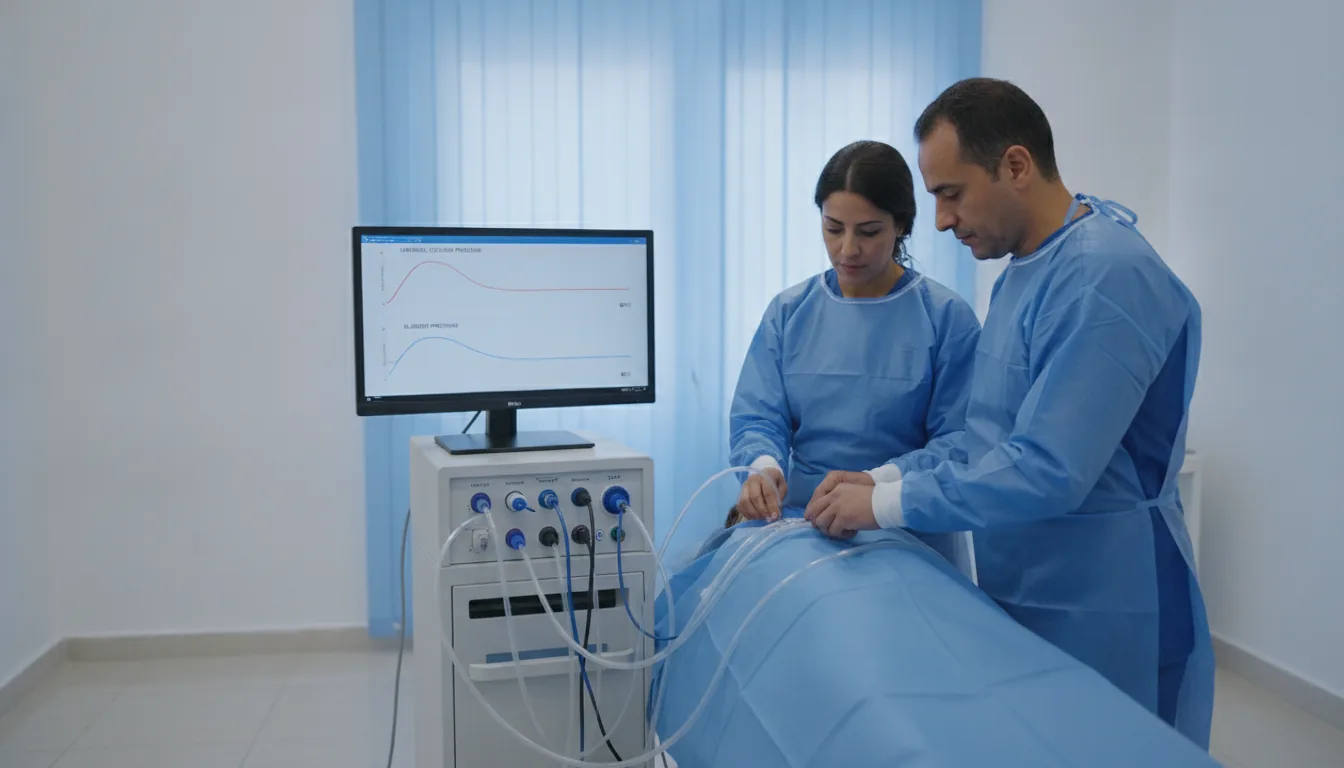
Urinary incontinence assessment
Complete, targeted urodynamic exploration to characterise the type of urinary incontinence and guide therapeutic management.
What is it?
When is it prescribed?
It helps explain leakage that occurs during effort, coughing or laughing, which is common in women.
It is useful for investigating urinary leakage that has appeared after a prostate operation.
It is offered when pressing urges with leakage persist despite medication.
When several types of leakage coexist, it helps determine which one to treat first.
It is one of the tests preparing for an operation for urinary leakage, in order to optimise its result.
It is useful when leakage reappears after an operation, to understand its cause.
It helps clarify the mechanism of leakage in the elderly in order to adapt management.
Preparation
How the exam is performed
Detailed questioning about the type of leakage and its impact
Free uroflowmetry and measurement of the post-void residual
Insertion of the bladder catheter and the rectal sensor
Filling cystometry with a search for involuntary contractions
Stress leak test: coughing and Valsalva at different filling volumes
Urethral profilometry at rest and during effort
Short pad test if necessary (1 hour with standardised activities)
Removal of the catheters and personalised advice
Duration
30 to 45 minutes (up to 1 hour 30 with the pad test)
Results
The assessment classifies the incontinence into three types: stress incontinence (sphincter deficiency or urethral hypermobility), urgency incontinence (detrusor overactivity) or mixed incontinence. The severity is quantified by the leak point pressure, the closure pressure and the pad test. The detailed report guides therapeutic management.
Risks and side effects
These risks remain rare. Your physician will explain them in detail before the exam.
Book an Appointment
Contact us to schedule your Incontinence assessment or request a quote.
Request a Quote +216 36 402 000