
Uroflowmetry

Uroflowmetry

Non-invasive measurement of urinary flow used to assess the quality of voiding and detect possible obstacles to the outflow of urine.

What is it?

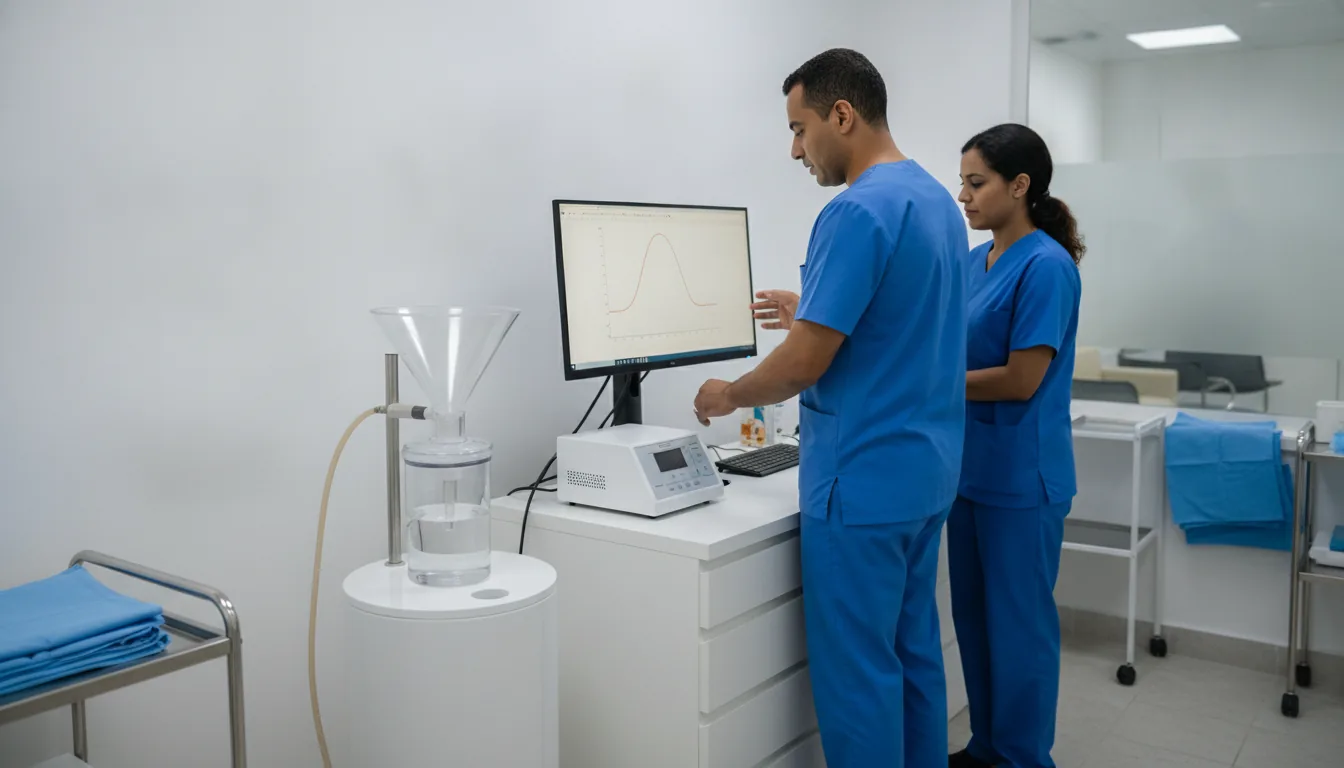
Uroflowmetry is the simplest and most commonly prescribed urodynamic test. It consists of measuring the urinary flow rate during voiding using an electronic flowmeter. The patient urinates into a measuring device that records in real time the volume of urine passed per unit of time. This test produces a characteristic voiding curve that provides information on the maximum flow rate (Qmax), the average flow rate, the voided volume and the voiding time. These parameters are essential for assessing bladder and sphincter function and detecting bladder outlet obstruction. Uroflowmetry is particularly useful in screening for benign prostatic hyperplasia in men, urethral strictures and bladder dysfunction. It is often the first test performed before considering a more comprehensive urodynamic assessment. The results are interpreted according to age, sex and voided volume. A maximum flow rate below 15 ml/s in men or 20 ml/s in women is generally considered abnormal and warrants further investigation.
Uroflowmetry

When is it prescribed?

Suspected benign prostatic hyperplasia

This test helps assess the urinary discomfort often linked to an enlarged prostate in men.

Voiding disorders (dysuria, urinary frequency)

It is offered when urinating becomes difficult or too frequent, to better understand these disorders.

Post-operative follow-up after prostate surgery

It verifies that voiding has improved after a prostate operation.

Suspected urethral stricture

It helps identify a narrowing of the urinary channel that would hinder the flow of urine.

Urinary incontinence assessment

It is part of the investigation of urinary leakage to clarify its mechanism.

Monitoring of neurogenic bladders

It helps monitor bladder function in people whose voiding is disturbed by a neurological disease.

Preparation

1Arrive with a full bladder (drink 500 ml of water about 1 hour before the test)
2Do not urinate in the 2 hours before the test
3Report any ongoing medication
4No specific dietary restrictions

How the exam is performed

1

Comfortable installation in a private booth

2

Voiding into an electronic flowmeter (special funnel)

3

Automatic recording of the flow curve

4

Measurement of the post-void residual by ultrasound after voiding

5

Result immediately available in the form of a curve

Duration

10 to 15 minutes

Results

The results are available immediately in the form of a flow curve. The physician analyses the maximum flow rate (Qmax), the average flow rate, the total voided volume and the shape of the curve to assess the quality of voiding.

Risks and side effects

No risk: a completely non-invasive test
Result may be inaccurate if the voided volume is insufficient (below 150 ml)

These risks remain rare. Your physician will explain them in detail before the exam.

Book an Appointment

Contact us to schedule your Uroflowmetry or request a quote.

Request a Quote +216 36 402 000

At a glance

Duration: 10 to 15 minutes
Preparation: Required
Book an appointment