
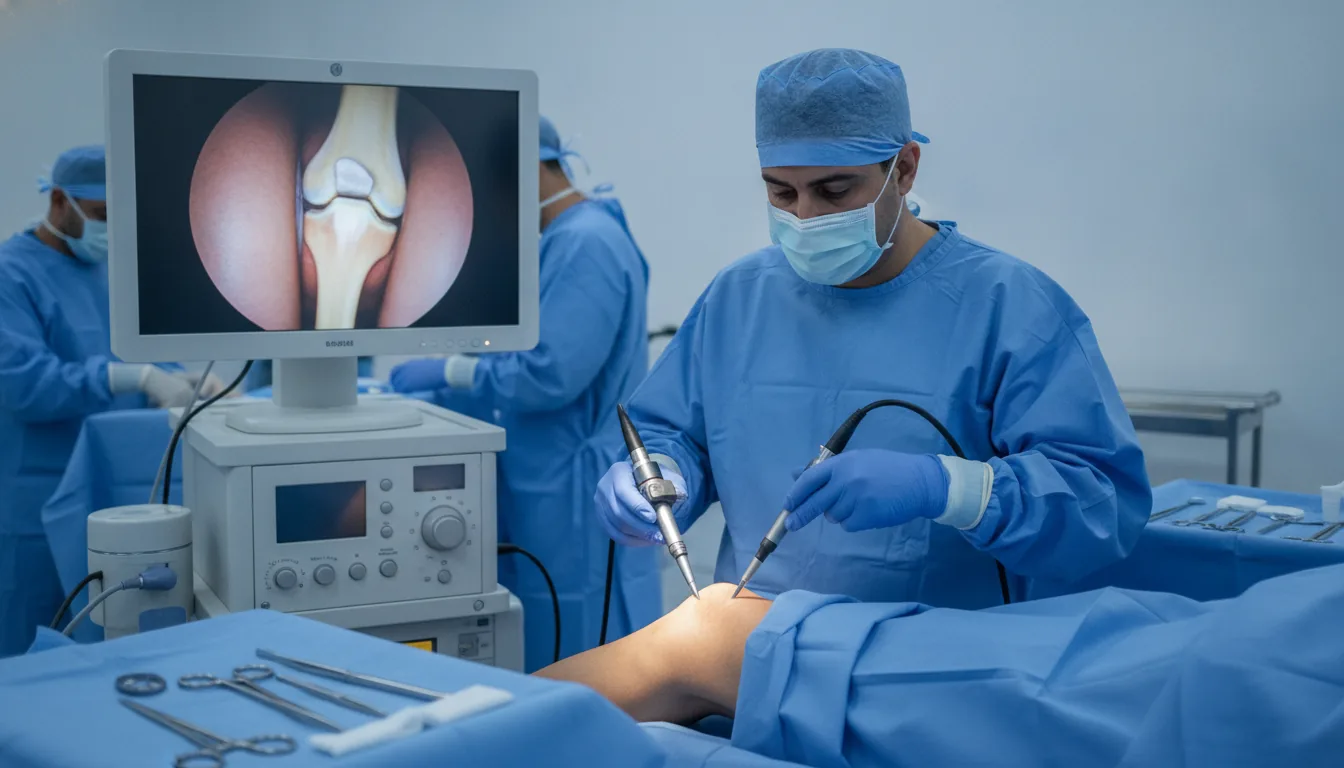
Arthroscopy (knee, shoulder, ankle)
Minimally invasive joint surgery performed through small incisions using a camera, to treat menisci, ligaments, tendons and cartilage.
What is it?
When is it indicated?
The menisci are the shock absorbers of the knee: when they tear, they cause pain and locking. Arthroscopy makes it possible to repair them or remove the damaged fragment through very small incisions.
A damaged area of cartilage can catch and make the joint painful. Arthroscopy makes it possible to treat it without opening the joint widely.
Abnormal friction between the shoulder tendons and the bone above them causes pain, especially at night and with the arm raised. Arthroscopy releases this impingement and repairs the tendons if needed.
When a joint dislocates or gives way repeatedly, the ligaments can be tightened or repaired under arthroscopy to restore confidence in one's movements.
Small fragments of bone or cartilage can break off and float in the joint, causing locking and pain. Arthroscopy makes it possible to remove them simply.
When a joint remains stiff despite rehabilitation, a release procedure under arthroscopy helps to recover a comfortable range of motion.
Preparation
Procedure
General or regional anesthesia depending on the joint and the anesthesiologist's assessment
Short incisions made around the joint
Introduction of the arthroscope and complete exploration of the joint
Treatment of the lesion using miniaturized instruments
Joint lavage and closure with a few stitches
Dressing, post-operative instructions and prompt return home
Duration
30 minutes to 1 hour depending on the procedure
Aftercare & Recovery
Recovery is generally straightforward, with a rapid return to weight-bearing or use of the limb depending on the treated lesion. Rehabilitation, started early, allows a progressive return to daily and then sporting activities, on the surgeon's advice.
Risks and side effects
These risks remain rare. Your surgeon will inform you in detail before the procedure.
Request a Quote
Contact us to schedule a consultation or receive a personalized quote.
Request a Quote +216 36 402 000