
Nerve conduction studies (NCS)
Centres/Neurophysiological Testing/Nerve conduction (NCS)

Nerve conduction studies (NCS)

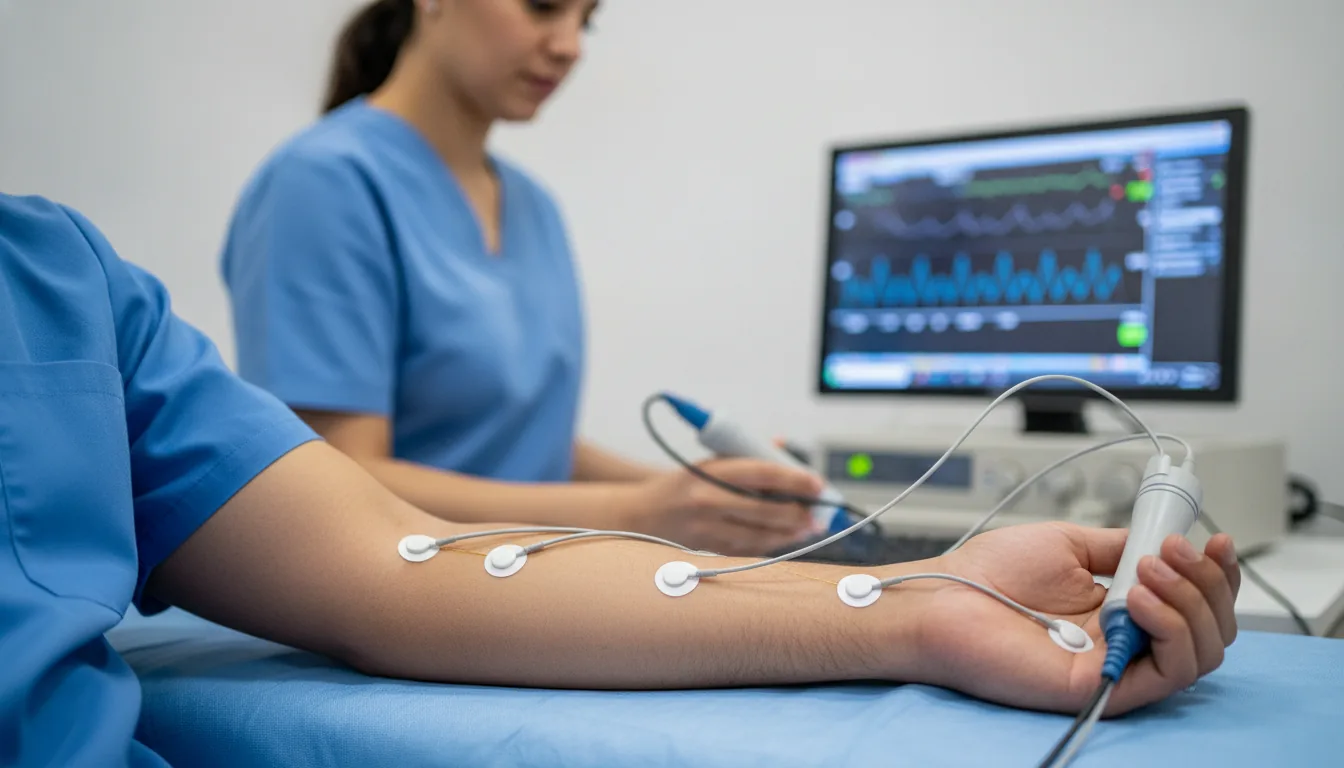
Measurement of the speed and quality of transmission of the nerve impulse along the peripheral nerves, essential for the diagnosis of neuropathies.

What is it?

Nerve conduction studies (NCS) are a neurophysiological examination that measures the ability of the peripheral nerves to conduct the electrical impulse. By stimulating a nerve at one point and recording the response at another point, it is possible to calculate the conduction velocity, the amplitude of the response and other parameters reflecting the integrity of the nerve. This examination makes it possible to distinguish two major types of nerve conditions: demyelinating conditions (destruction of the myelin sheath surrounding the nerve, leading to a slowing of conduction) and axonal conditions (destruction of the axon itself, leading to a reduction in the amplitude of the responses). This distinction is fundamental because it points towards different causes and treatments. Nerve conduction studies are systematically combined with needle EMG to make up a complete electroneuromyographic assessment. They are particularly effective in the diagnosis of entrapment syndromes (carpal tunnel, Guyon's canal, cubital tunnel at the elbow), polyneuropathies and polyradiculoneuropathies. The Clinique Pasteur in Tunis uses high-resolution digital electroneuromyography equipment, allowing precise and reproducible measurements. The examinations are carried out under standardised skin-temperature conditions, ensuring the reliability of the results.
Nerve conduction studies (NCS)

When is it indicated?

Carpal tunnel syndrome

It helps confirm the compression of the nerve at the wrist, often responsible for tingling in the hand.

Guyon's canal syndrome (ulnar nerve at the wrist)

It explores the compression of another nerve at the wrist that can affect certain fingers.

Compression of the ulnar nerve at the elbow

It is useful when faced with tingling or weakness related to compression of the nerve at the elbow.

Polyneuropathies (diabetic, alcoholic, toxic, inflammatory)

It makes it possible to assess a widespread nerve condition, for example related to diabetes, and to specify its nature.

Acute polyradiculoneuropathy (Guillain-Barré syndrome)

It helps rapidly recognise this sudden-onset nerve condition, which requires urgent management.

Chronic polyradiculoneuropathy (CIDP)

It contributes to the diagnosis of a nerve condition developing over a long period and which may benefit from treatment.

Mononeuropathies and multiple mononeuropathies

It helps explore the involvement of one or several distinct nerves in order to understand its origin.

Hereditary neuropathies (Charcot-Marie-Tooth disease)

It provides useful information when a familial nerve disease is suspected.

Monitoring of neurotoxic treatments (chemotherapy)

It makes it possible to monitor the nerves in patients receiving treatments that may affect them.

Preparation

1No fasting is required.
2Keep the hands and feet warm before the examination (cold slows nerve conduction and can distort the results).
3Come with clean skin, without cream or oil.
4Report the medications you are taking, in particular neurotoxic treatments.
5Report the presence of a pacemaker or an implantable defibrillator.
6Bring the results of previous examinations and the physician's prescription.

Procedure

1

The patient is settled comfortably, with the limbs to be examined uncovered.

2

Checking of the skin temperature (warming may be necessary if the skin is too cold).

3

Placement of surface electrodes (adhesive) on the skin over the nerve and the muscle to be studied.

4

Electrical stimulation of the nerve using a bipolar stimulator placed on the skin: the stimulation causes a sensation of tingling or a brief contraction.

5

Recording of the muscle response (motor conduction) or sensory response (sensory conduction).

6

Stimulation at different levels along the nerve to calculate the segmental conduction velocity.

7

Study of several nerves of the upper and/or lower limbs according to the clinical context.

8

Measurement of the distal latencies, the amplitudes and the conduction velocities.

Duration

30 to 60 minutes

Results

The results are analysed by the neurophysiologist in comparison with the normal reference values. The report is available within 24 to 48 hours and details the conduction parameters of each nerve studied.

Risks and side effects

An unpleasant but bearable sensation during the electrical stimulations.
No risk for patients carrying a pacemaker if the precautions are observed.

These risks remain rare. Your physician will inform you in detail before the examination.

Book an Appointment

Contact us to schedule your examination or request a quote.

Request a Quote +216 36 402 000

At a glance

Duration: 30 to 60 minutes
Preparation: Required
Book an appointment