
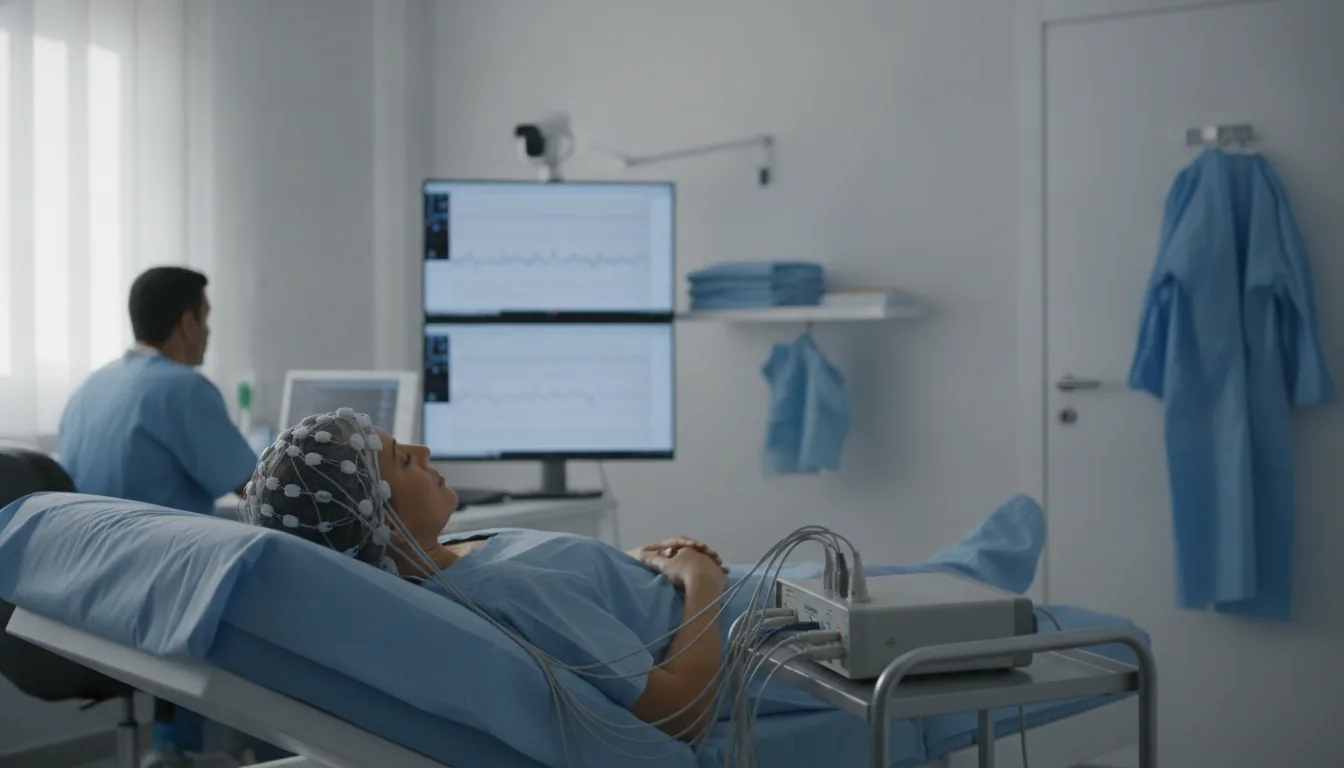
Prolonged video-EEG (continuous monitoring)

Prolonged video-EEG (continuous monitoring)

Simultaneous and prolonged recording of the brain's electrical activity and the patient's behaviour by video, making it possible to correlate clinical manifestations with EEG abnormalities.

What is it?

Prolonged video-EEG is a reference examination that combines the continuous recording of the brain's electrical activity (EEG) with synchronised video monitoring of the patient. This technique makes it possible to establish a precise correlation between the clinical manifestations observed and the corresponding cerebral electrical abnormalities. This examination is carried out over a prolonged period, ranging from a few hours to several days depending on the indications. The patient is admitted to a dedicated unit, under the constant supervision of a specialised team. The main objective is to capture spontaneous clinical events (epileptic seizures, faints, abnormal movements) and to analyse their electrophysiological correlate. Video-EEG is particularly crucial in the pre-surgical assessment of epilepsy, where it makes it possible to precisely locate the epileptogenic focus. It is also essential for distinguishing epileptic seizures from psychogenic non-epileptic seizures (PNES), a distinction that has major therapeutic implications. The Clinique Pasteur in Tunis has a video-EEG unit equipped with the latest-generation equipment, with high-definition infrared cameras for night-time monitoring and a digital recording system allowing detailed retrospective analysis.
Prolonged video-EEG (continuous monitoring)

When is it indicated?

Pre-surgical assessment of drug-resistant epilepsy

It is carried out when medication is not enough to control the epilepsy and an operation is being considered, in order to properly prepare this decision.

Differential diagnosis between epileptic seizures and psychogenic non-epileptic seizures

By filming the seizures while recording the brain's activity, it helps distinguish a genuine epileptic seizure from a faint of another nature.

Precise classification of the type of epilepsy

It makes it possible to specify the exact form of epilepsy in order to choose the best-suited treatment.

Localisation of the epileptogenic focus before surgery

It helps identify the area of the brain from which the seizures originate, essential information before an operation.

Quantification of seizures and interictal abnormalities

It makes it possible to count and better characterise the seizures and the abnormalities observed between seizures.

Assessment of the effectiveness of an antiepileptic treatment

It helps check whether a treatment is working well by observing the seizures and the brain activity over a prolonged period.

Paroxysmal events of undetermined nature

It is useful when faced with sudden, repeated episodes whose cause remains to be determined.

Preparation

1A prior consultation with the neurologist is required to plan the duration of the monitoring.
2Prepare personal belongings for a stay of 24 hours to several days (clothing, toiletries).
3Wash your hair without styling products.
4A gradual reduction of antiepileptic treatments may be decided by the physician to encourage the occurrence of seizures.
5Do not stop or change treatments on your own without medical approval.
6Arrange for a companion if possible.
7Bring all the results of previous examinations (EEG, brain MRI, CT scans).

Procedure

1

Admission to the video-EEG unit and settling of the patient into a dedicated room.

2

Placement of the EEG electrodes with reinforced fixation (collodion) for a prolonged recording.

3

Calibration of the video system with cameras positioned to capture the patient's whole body.

4

Continuous 24-hour recording of the EEG and video, with monitoring by the nursing staff.

5

The patient can move around within a limited area, and eat and drink normally.

6

In the event of a seizure, the nursing team carries out standardised clinical testing (verbal instructions, memory tests).

7

At the end of the monitoring, the electrodes are removed and the antiepileptic treatment is resumed at the usual dose.

Duration

24 hours to 5 days depending on the indication

Results

The complete analysis of the recording (EEG and video) is carried out by the neurophysiologist. A detailed report including a description of the events captured is provided within one week. The results are discussed at a follow-up consultation.

Risks and side effects

Risk of more frequent epileptic seizures in the event of treatment reduction, overseen by continuous medical supervision.
Discomfort related to the prolonged wearing of the electrodes (possible skin irritation).
Very rarely, status epilepticus requiring immediate medical intervention (a resuscitation team is available).

These risks remain rare. Your physician will inform you in detail before the examination.

Book an Appointment

Contact us to schedule your examination or request a quote.

Request a Quote +216 36 402 000

At a glance

Duration: 24 hours to 5 days depending on the indication
Preparation: Required
Book an appointment