
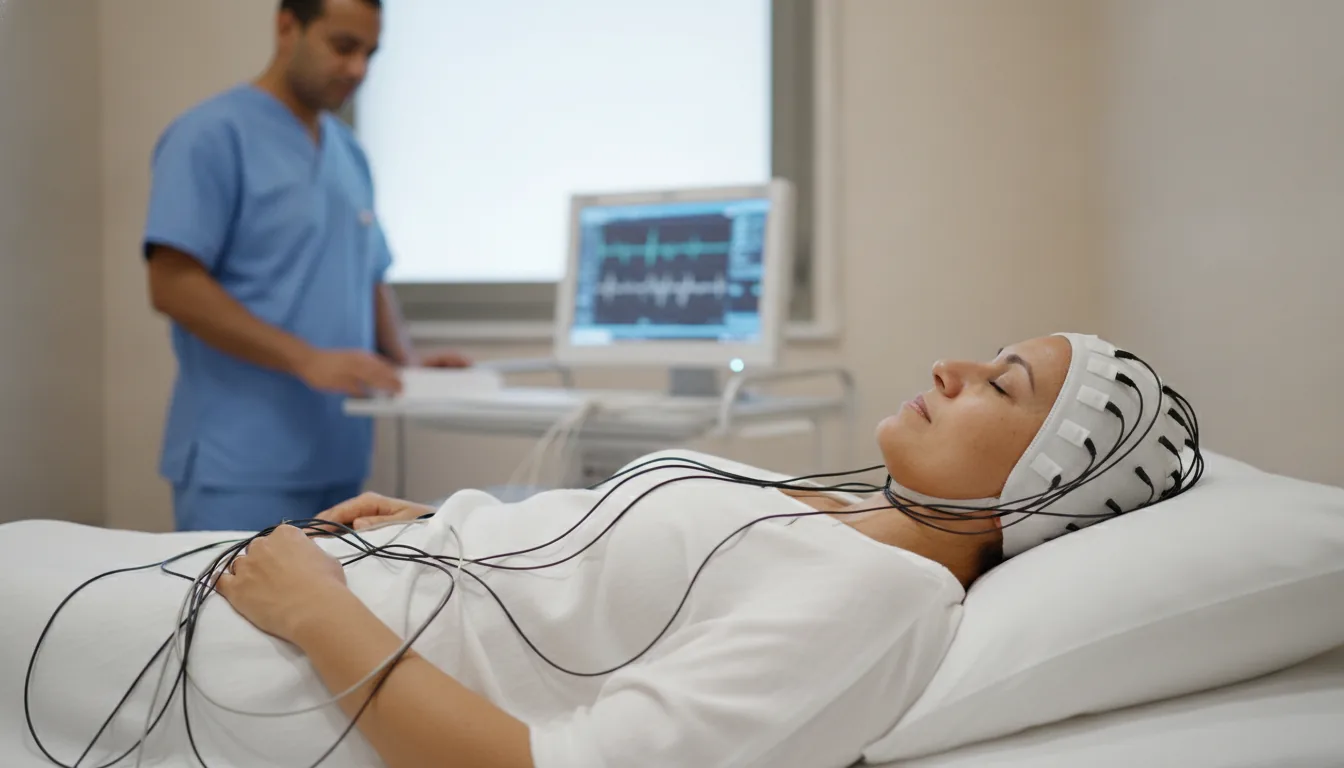
Sleep electroencephalogram

Sleep electroencephalogram

Recording of the brain's electrical activity during sleep, particularly useful for detecting epileptic abnormalities that appear only during sleep.

What is it?

The sleep electroencephalogram is a neurophysiological examination that records the brain's electrical activity during the different phases of sleep. Many epileptic abnormalities appear only during sleep, making this examination essential in certain clinical situations. Sleep is a powerful activator of interictal epileptic abnormalities. The transitions between wakefulness and sleep, as well as the slow-wave sleep stages, are particularly conducive to the appearance of epileptic discharges. The sleep EEG can therefore reveal abnormalities that escape the standard waking EEG. This examination is particularly indicated in children with benign focal epilepsy with centrotemporal spikes, in idiopathic generalised epilepsies, or when the waking EEG is normal despite a strong clinical suspicion of epilepsy. It is also useful in the exploration of sleep disorders of neurological origin. The Clinique Pasteur in Tunis has an environment specially arranged to encourage the patient's natural onset of sleep, with quiet, dark and air-conditioned rooms. Partial sleep deprivation the night before is generally recommended to facilitate falling asleep during the examination.
Sleep electroencephalogram

When is it indicated?

Normal waking EEG despite a strong suspicion of epilepsy

It is offered when a first waking examination showed nothing while the clinical signs strongly suggest epilepsy, since some abnormalities appear only during sleep.

Benign focal epilepsy of childhood (centrotemporal spikes)

It helps identify this type of childhood epilepsy whose abnormalities are mainly visible during sleep.

Childhood absence epilepsy

It helps confirm the brief absences that a child may present and to guide management.

Landau-Kleffner syndrome

It is useful when language disorders in a child raise the suspicion of this particular form of sleep-related epilepsy.

Continuous spike-waves during sleep (CSWS)

It makes it possible to look for very frequent abnormal electrical activity during sleep, which can affect a child's learning.

Temporal lobe epilepsies

It helps reveal abnormalities in this region of the brain that often become apparent during sleep.

Paroxysmal sleep disorders to be distinguished from epilepsy

It helps distinguish a genuine epileptic seizure from other phenomena occurring during sleep.

Parasomnias requiring a differential diagnosis with epilepsy

It is requested to tell the difference between abnormal sleep behaviours and epileptic seizures.

Post-therapeutic follow-up of certain epilepsies

It makes it possible to monitor the course and the effect of treatment in certain sleep-related epilepsies.

Preparation

1Carry out partial sleep deprivation: go to bed 2 to 3 hours later than usual and get up 2 to 3 hours earlier.
2Wash your hair without styling products (gel, hairspray, oil).
3Do not consume coffee, tea, cola or energy drinks in the 24 hours before the examination.
4Have a light meal before coming.
5Do not stop antiepileptic treatments, unless expressly instructed by the physician.
6Bring comfortable clothing to help you fall asleep.
7Bring the prescription and the results of previous EEGs.

Procedure

1

Welcoming the patient and settling them into a quiet, dark room at a comfortable temperature.

2

Placement of the electrodes on the scalp according to the international 10-20 system.

3

Initial recording of a few minutes while awake (eyes open then eyes closed).

4

The patient is invited to fall asleep naturally, aided by the prior sleep deprivation.

5

Continuous recording throughout the sleep period, ideally covering the light and deep slow-wave sleep stages.

6

Activation procedures (hyperpnoea and IPS) carried out on waking.

7

Removal of the electrodes and cleaning.

Duration

1 hour 30 to 2 hours

Results

The report is drawn up by the neurophysiologist after a detailed analysis of the waking and sleep recording. The results are available within 48 hours.

Book an Appointment

Contact us to schedule your examination or request a quote.

Request a Quote +216 36 402 000

At a glance

Duration: 1 hour 30 to 2 hours
Preparation: Required
Non-invasive examination
Book an appointment