
Study of the neuromuscular junction
Centres/Neurophysiological Testing/Neuromuscular junction

Study of the neuromuscular junction

Exploration of the transmission of the nerve impulse between the nerve and the muscle, essential for the diagnosis of myasthenia and myasthenic syndromes.

What is it?

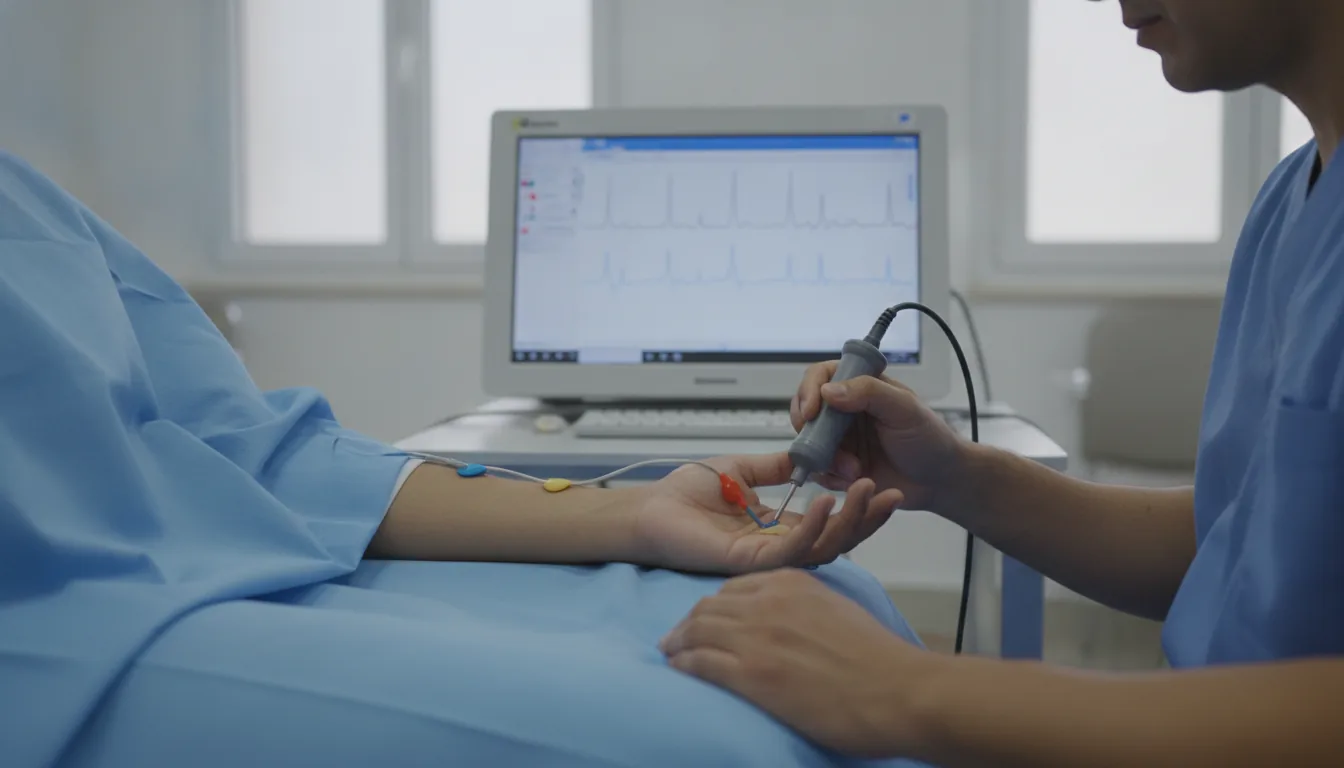
The study of the neuromuscular junction is a specialised neurophysiological examination that assesses the synaptic transmission between the motor nerve and the muscle. It is based mainly on two techniques: repetitive nerve stimulation (RNS) and, in some cases, single-fibre EMG. Repetitive nerve stimulation consists of stimulating a motor nerve at a low frequency (3 Hz) and a high frequency (20-50 Hz) while recording the muscle response. In myasthenia, an autoimmune disease of the neuromuscular junction, a characteristic decrement (a progressive decrease in the amplitude of the responses) is observed with low-frequency stimulation. Conversely, in Lambert-Eaton syndrome, an increment (an increase in amplitude) is observed with high-frequency stimulation. Single-fibre EMG is the most sensitive technique for detecting a dysfunction of the neuromuscular junction. It measures the jitter (the variability of the latency of neuromuscular transmission between two muscle fibres of the same motor unit). An increased jitter is a very early marker of myasthenia, even when repetitive stimulation is still normal. The Clinique Pasteur in Tunis offers the full range of techniques for exploring the neuromuscular junction, allowing an early and precise diagnosis of myasthenia and related syndromes.
Study of the neuromuscular junction

When is it indicated?

Suspected myasthenia (ptosis, diplopia, muscle fatigability)

It helps explore this disease when a drooping eyelid, double vision or unusual muscle fatigue appear.

Known myasthenia: assessment of severity and therapeutic follow-up

It makes it possible to measure the extent of the disease and to follow the effect of the treatment over time.

Suspected Lambert-Eaton syndrome

It helps recognise this disease, similar to myasthenia, which presents with muscle weakness.

Botulism

It provides useful elements for exploring the muscle disorders related to this rare poisoning.

Organophosphate poisoning

It helps assess the impact of these toxic substances on the transmission between nerve and muscle.

Congenital myasthenic syndromes

It is useful for exploring forms of muscle weakness present since birth.

Unexplained muscle fatigability

It is offered when abnormal muscle fatigue needs to be explored.

Differential diagnosis between myasthenia and myopathy

It helps distinguish a problem of transmission between nerve and muscle from a disease of the muscle itself.

Preparation

1Inform the physician of all current medications, in particular anticholinesterases (pyridostigmine/Mestinon): stopping them 12 to 24 hours before the examination may be requested by the physician to increase the sensitivity of the test.
2Do not stop the medications without the explicit approval of the physician.
3Avoid intense physical exertion in the hours before the examination.
4The examination does not require fasting.
5Keep the limbs warm.
6Bring the recent laboratory tests (anti-acetylcholine receptor antibodies, anti-MuSK).

Procedure

1

The patient is settled comfortably, with the limb to be studied well positioned and immobile.

2

Placement of surface electrodes on the target muscle (usually the nasalis, orbicularis oculi, trapezius or abductor digiti minimi muscle).

3

Repetitive nerve stimulation at a low frequency (3 Hz): trains of 5 to 10 stimulations.

4

Analysis of the decrement: looking for a decrease in amplitude greater than 10 % between the 1st and the 4th-5th response.

5

Stimulation at a high frequency (20-50 Hz) or after a maximal voluntary effort of 10 seconds (post-exercise facilitation).

6

Looking for a post-exercise increment (Lambert-Eaton syndrome).

7

Fatigue test: stimulation after a prolonged effort of 1 minute (post-exercise exhaustion).

8

If necessary, single-fibre EMG to measure the neuromuscular jitter.

Duration

30 to 60 minutes

Results

The results are interpreted immediately by the neurophysiologist. A detailed report specifying the presence or absence of a decrement/increment and the value of the jitter is available within 24 to 48 hours.

Risks and side effects

An unpleasant sensation during the repetitive electrical stimulations.
In the case of single-fibre EMG: slight pain when the needle is inserted.

These risks remain rare. Your physician will inform you in detail before the examination.

Book an Appointment

Contact us to schedule your examination or request a quote.

Request a Quote +216 36 402 000

At a glance

Duration: 30 to 60 minutes
Preparation: Required
Book an appointment