
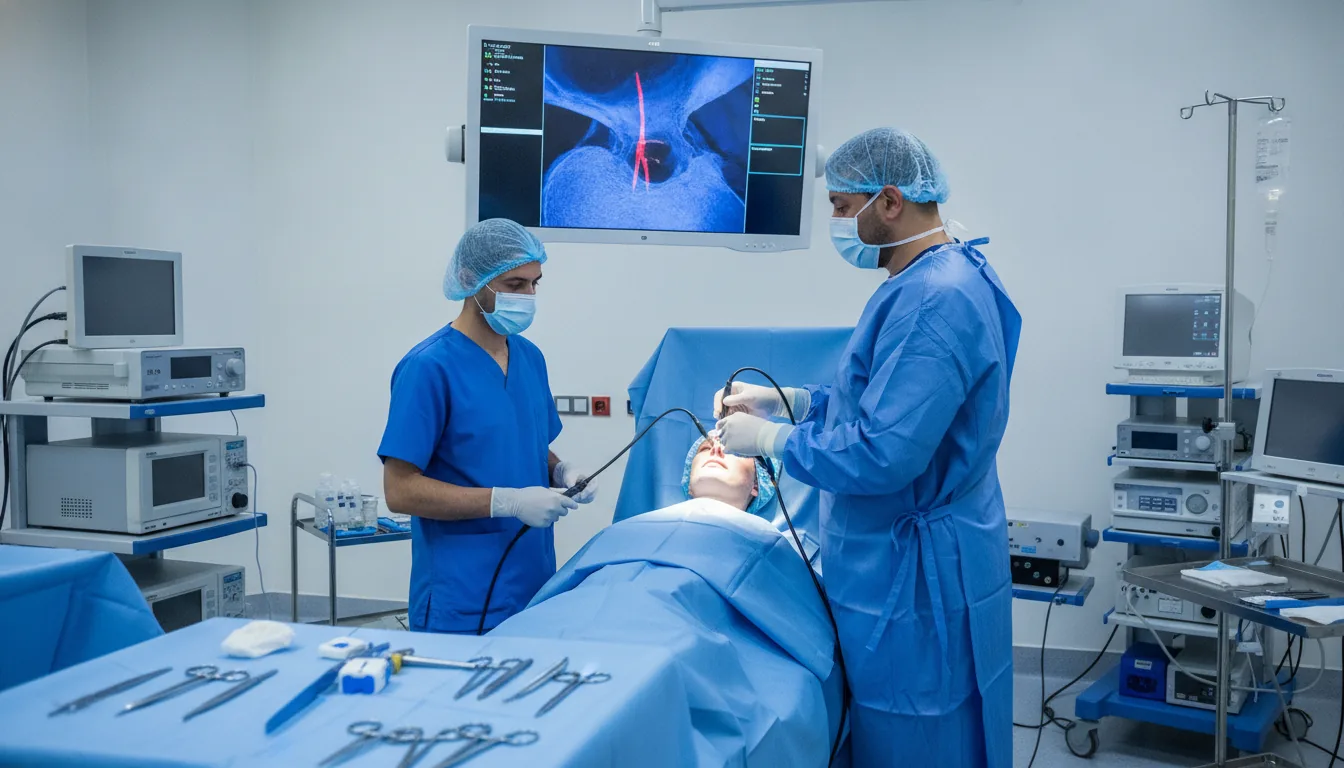
Endoscopic sinonasal surgery
Surgeries/ENT/Sinonasal endoscopy

Endoscopic sinonasal surgery

The gold-standard minimally invasive approach for operating on the nose and sinuses through the natural passages, under high-definition video control.

What is it?

Endoscopic sinonasal surgery encompasses all operations on the nose and sinuses performed through the natural passages, under the control of a high-definition endoscope. This minimally invasive approach has transformed sinus surgery: no incision on the face, greater precision and considerably more comfortable recovery. Thanks to fine optics and dedicated instruments, the surgeon has a perfect view of the nasal and sinus cavities and treats lesions with great precision: opening the sinuses, removing polyps, excising certain benign tumours, treating nasal obstruction or closing leaks. The range of applications of this technique is expanding steadily. Endoscopy also makes it possible to reach deep areas that were once difficult to access, while preserving neighbouring structures, notably the orbit and the skull base, whose anatomy is studied in detail on the pre-operative CT scan. At Clinique Pasteur Tunis, endoscopic sinonasal surgery relies on a high-definition ENT endoscope and the expertise of surgeons highly skilled in minimally invasive techniques, for precise, safe and comfortable procedures.
Endoscopic sinonasal surgery

When is it indicated?

Chronic sinusitis and nasal polyposis

When the sinuses remain blocked or overrun by polyps despite treatments, endoscopy reopens them through the nostrils, with no incision on the face.

Nasal obstruction of sinus origin

If the blocked nose stems from a sinus problem, the endoscopic approach treats the cause to restore free breathing.

Certain benign tumours of the nose and sinuses

Benign tumours can develop in the nasal passages; many can now be removed through the natural passages, under video control.

Mucoceles and sinus cysts

These pockets of secretions that develop in a sinus cause heaviness and pain; opening them endoscopically makes the discomfort disappear.

Chronic dacryocystitis (tear duct obstruction) in collaboration with the relevant specialists

When the tear duct becomes blocked and the eye waters constantly, an endoscopic procedure performed through the nose can restore drainage, in liaison with the relevant specialists.

Preparation

1Recent sinus CT scan, essential for planning the procedure
2Possible preparatory medical treatment
3Anaesthesia consultation
4Fast for 6 hours before the procedure
5Stopping smoking recommended

Procedure

1

General anaesthesia

2

Insertion of the high-definition endoscope through the nostrils

3

Precise treatment of the lesions under continuous video control

4

Preservation of neighbouring anatomical structures

5

Possible placement of temporary nasal packing

6

Monitoring in the recovery room

Duration

1 to 2 hours depending on the extent of the procedure

Aftercare & Recovery

Discharge takes place the same day or the following day. Regular nasal rinses are the key to good healing. Nasal and respiratory comfort improves gradually over the weeks, with follow-up consultations to support the recovery.

Risks and side effects

Mild nasal bleeding in the first few days
Transient nasal crusting and dryness
Possible recurrence of certain lesions (polyps), monitored during follow-up

These risks remain rare. Your surgeon will inform you in detail before the procedure.

Request a Quote

Contact us to schedule a consultation or receive a personalized quote.

Request a Quote +216 36 402 000

At a glance

Duration: 1 to 2 hours depending on the extent of the procedure
Preparation: Required
Dedicated specialist team