
Motor evoked potentials (MEP)

Motor evoked potentials (MEP)

Assessment of the corticospinal motor pathway by transcranial magnetic stimulation, measuring the central motor conduction time from the motor cortex to the muscles.

What is it?

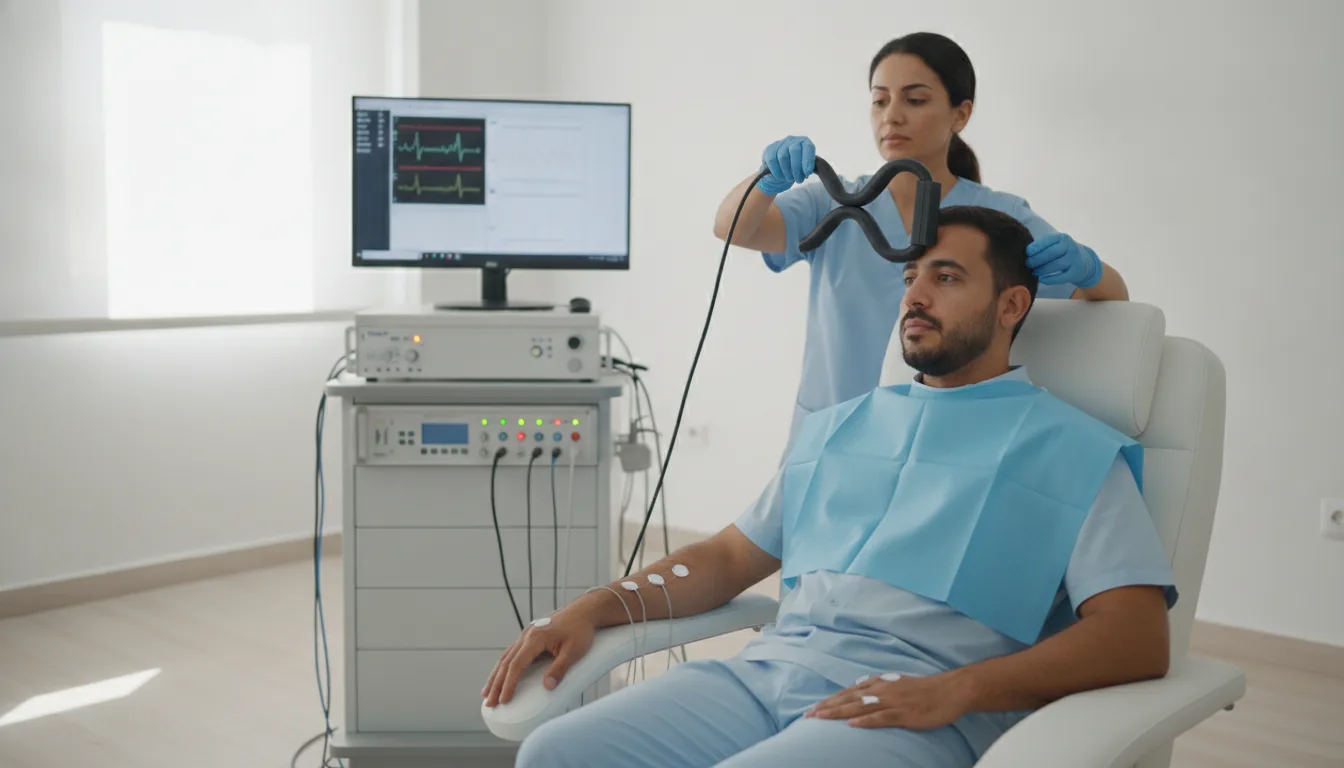
Motor evoked potentials (MEP) explore the integrity of the corticospinal motor pathway (the pyramidal tract) using transcranial magnetic stimulation (TMS). A magnetic coil placed on the scalp generates a brief and powerful magnetic field that induces an electrical current in the motor cortex, activating the pyramidal neurons. The resulting muscle response is recorded by surface electrodes. The examination measures the central motor conduction time (CMCT), that is, the time needed for the nerve impulse to travel along the pyramidal tract from the motor cortex to the motor neurons of the spinal cord. A lengthening of the CMCT or an absence of response indicates a condition of the central motor pathway. MEP are complementary to SEP: while SEP explore the ascending sensory pathways, MEP assess the descending motor pathways. Together, they provide a complete functional mapping of the spinal cord. MEP are particularly useful in the diagnosis and follow-up of multiple sclerosis, myelopathies and motor neuron diseases. The Clinique Pasteur in Tunis has a latest-generation transcranial magnetic stimulator, allowing focal and reproducible stimulation. The examination is non-invasive, painless and without side effects in the vast majority of cases.
Motor evoked potentials (MEP)

When is it indicated?

Multiple sclerosis (assessment of pyramidal tract involvement)

It helps assess the pathways that control movement as part of the assessment of multiple sclerosis.

Cervical spondylotic myelopathy

It is useful when wear of the neck vertebrae compresses the spinal cord and hampers the control of movement.

Amyotrophic lateral sclerosis (ALS) and motor neuron diseases

It provides elements to explore diseases affecting the nerves that control the muscles.

Spinal cord compression

It makes it possible to assess the impact of a spinal cord compression on motor function.

Paraparesis or tetraparesis of undetermined origin

It helps understand the origin of weakness affecting the lower limbs or all of the limbs.

Unexplained central motor deficit

It is offered when faced with a loss of strength related to the central nervous system whose cause remains to be determined.

Post-therapeutic follow-up of motor pathway conditions

It makes it possible to follow the course and the effect of treatments in diseases affecting the control of movement.

Distinction between central and peripheral involvement of the motor pathway

It helps determine whether weakness originates from the brain and spinal cord or rather from the peripheral nerves.

Preparation

1No particular preparation is required.
2It is imperative to report the presence of a pacemaker, an implantable defibrillator, cochlear implants or any intracranial ferromagnetic material (surgical clips).
3Report any history of epilepsy (relative contraindication).
4Report a pregnancy.
5Bring the results of brain and spinal MRIs if available.
6Remove metal objects (earrings, hairpins, necklaces) before the examination.

Procedure

1

The patient is settled in a seated or semi-reclined position.

2

Placement of surface electrodes on the target muscles (muscles of the hand, arm or leg depending on the context).

3

Positioning of the magnetic coil on the scalp, over the motor cortex.

4

Triggering of the magnetic stimulation: the patient feels a slight click and a brief muscle contraction.

5

Recording of the motor response at the level of the target muscles.

6

Spinal stimulation (cervical or lumbar) to measure the peripheral conduction time.

7

Calculation of the central motor conduction time by subtraction.

8

The examination is carried out bilaterally to allow a comparison.

Duration

30 to 45 minutes

Results

The results are available within 24 to 48 hours. The report specifies the CMCT in the upper and lower limbs, the amplitudes of the motor responses and their comparison with the normative values.

Risks and side effects

Absolute contraindication in carriers of a pacemaker, an implantable defibrillator or intracranial ferromagnetic material.
An extremely low theoretical risk of triggering an epileptic seizure (precautions in epileptic patients).
Possible transient headaches after the examination.

These risks remain rare. Your physician will inform you in detail before the examination.

Book an Appointment

Contact us to schedule your examination or request a quote.

Request a Quote +216 36 402 000

At a glance

Duration: 30 to 45 minutes
Preparation: Required
Book an appointment