
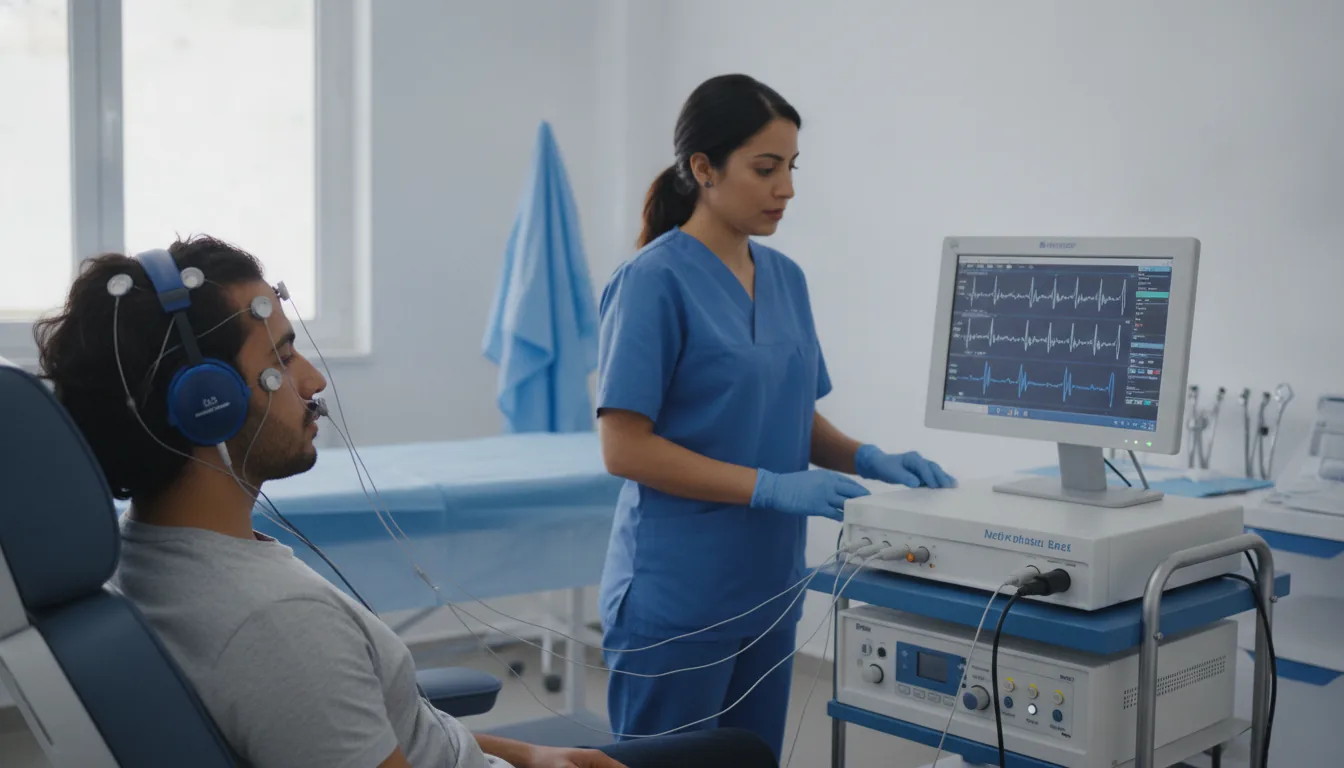
Auditory evoked potentials (AEP)
Recording of the electrical responses of the auditory pathways from the cochlear nerve to the brainstem, making it possible to assess hearing and the integrity of the central auditory pathways.
What is it?
When is it indicated?
It helps explore a benign tumour of the hearing nerve when it is suspected.
It is useful when faced with a hearing loss mainly affecting one ear, to specify its origin.
It makes it possible to objectively check a newborn's hearing, without any need for cooperation.
It helps identify a subtle condition of the auditory pathways as part of the assessment of multiple sclerosis.
It provides information on the functioning of a deep region of the brain when it may be affected.
It helps the medical team assess the state of the brain in patients in critical condition.
It offers a reliable way to test hearing in a person who cannot respond to the usual tests.
It is offered when faced with sounds perceived in a single ear, to look for the cause.
Preparation
Procedure
The patient is settled in a semi-reclined position in a quiet room.
Placement of electrodes on the scalp (vertex) and the earlobes or mastoids.
Audio headphones are placed over the patient's ears.
Sound clicks are delivered to one ear, the other receiving a masking noise.
The computer averages the electrical responses over 1,000 to 2,000 stimulations to extract waves I to V.
The examination is carried out for each ear separately, at different intensities if necessary.
Analysis of the absolute latencies of waves I, III and V and of the inter-wave intervals (I-III, III-V, I-V).
Duration
30 to 45 minutes
Results
The results are interpreted by the neurophysiologist and correlated with the clinical and audiometric data. The report is available within 24 to 48 hours.
Book an Appointment
Contact us to schedule your examination or request a quote.
Request a Quote +216 36 402 000