
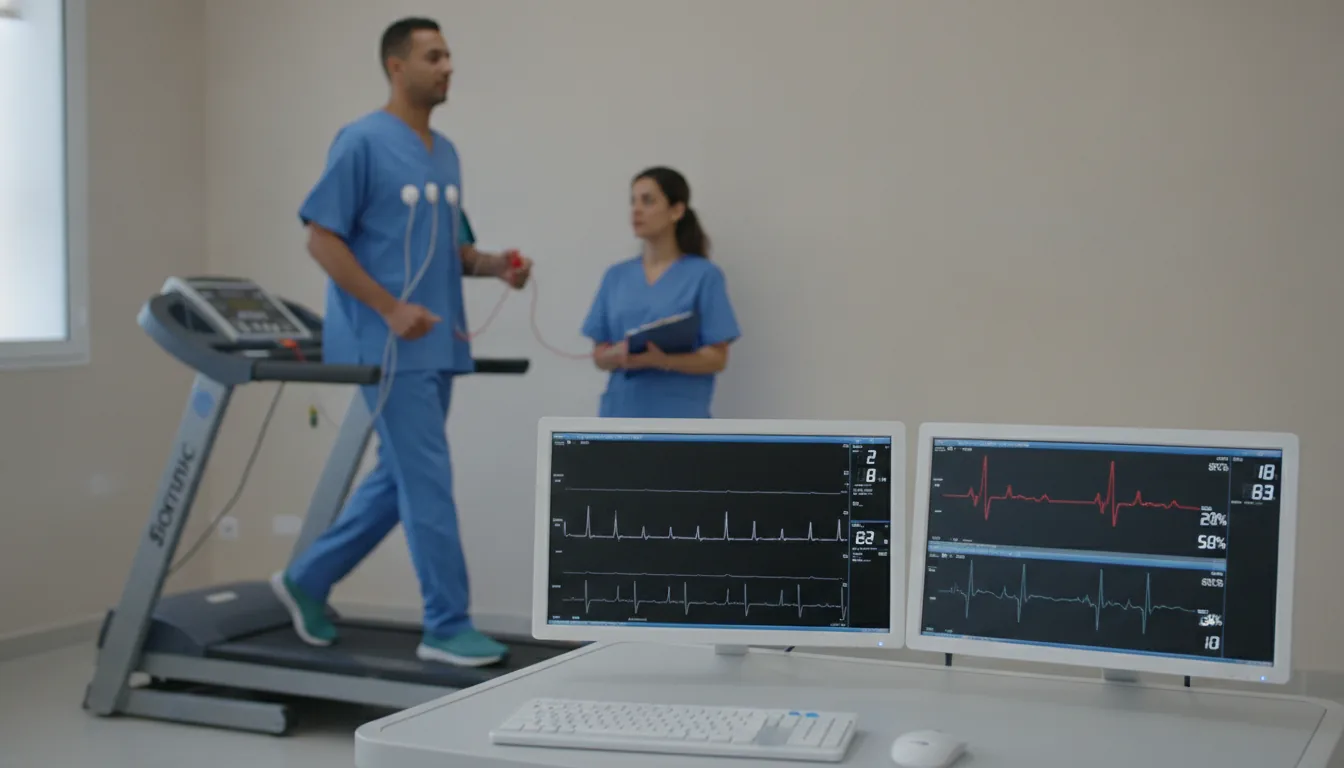
Treadmill stress test with monitoring
Comprehensive stress test with continuous monitoring of the ECG, blood pressure and oxygen saturation, to assess functional capacity and detect myocardial ischemia.
What is it?
When is it indicated?
By working the heart progressively under supervision, the test reveals a shortage of blood supply to the heart muscle that would remain invisible at rest.
The test precisely measures the level of exertion you can achieve, very useful information for the doctor to assess your cardiac fitness and track your progress.
After a heart attack or cardiac alert, this supervised test checks the heart's recovery and helps organize the next steps of care.
Before starting a heart rehabilitation program, the test determines the appropriate, safe level of exercise for each patient.
The examination checks that the heart speeds up normally as exercise increases; a heart that does not accelerate enough can explain fatigue and breathlessness.
Some irregular heartbeats only appear during exercise: the test triggers them in a safe setting so they can be recorded and analyzed.
When abnormal shortness of breath occurs during exercise, the test helps determine whether it comes from the heart, physical condition or another cause.
The examination observes how blood pressure changes during exercise, because an excessive rise or an abnormal drop is important information for the doctor.
For a cardiac patient wishing to engage in physical activity, the test confirms that the intended sport is compatible with their state of health.
Preparation
Procedure
Placement of the 12-lead ECG electrodes on the chest
Fitting of the blood pressure cuff and the oxygen saturation sensor
Recording of the ECG and blood pressure at rest
The patient starts walking slowly on the treadmill
The speed and incline are increased progressively according to the chosen protocol
The ECG, blood pressure and saturation are monitored continuously on screen
The cardiologist continuously assesses symptoms and the measured parameters
Exercise continues until the theoretical maximum heart rate, exhaustion or the appearance of stopping criteria
Active then passive recovery phase of 6 to 10 minutes
Full analysis of all the recorded parameters
Duration
45 minutes to 1 hour (including preparation, exercise and recovery)
Results
Results are communicated by the cardiologist immediately after the examination. A full report including the hemodynamic parameters, the ECG tracings and the interpretation is given to the patient.
Risks and side effects
These risks remain rare. Your physician will inform you in detail before the examination.
Book an Appointment
Contact us to schedule your examination or request a quote.
Request a Quote +216 36 402 000