
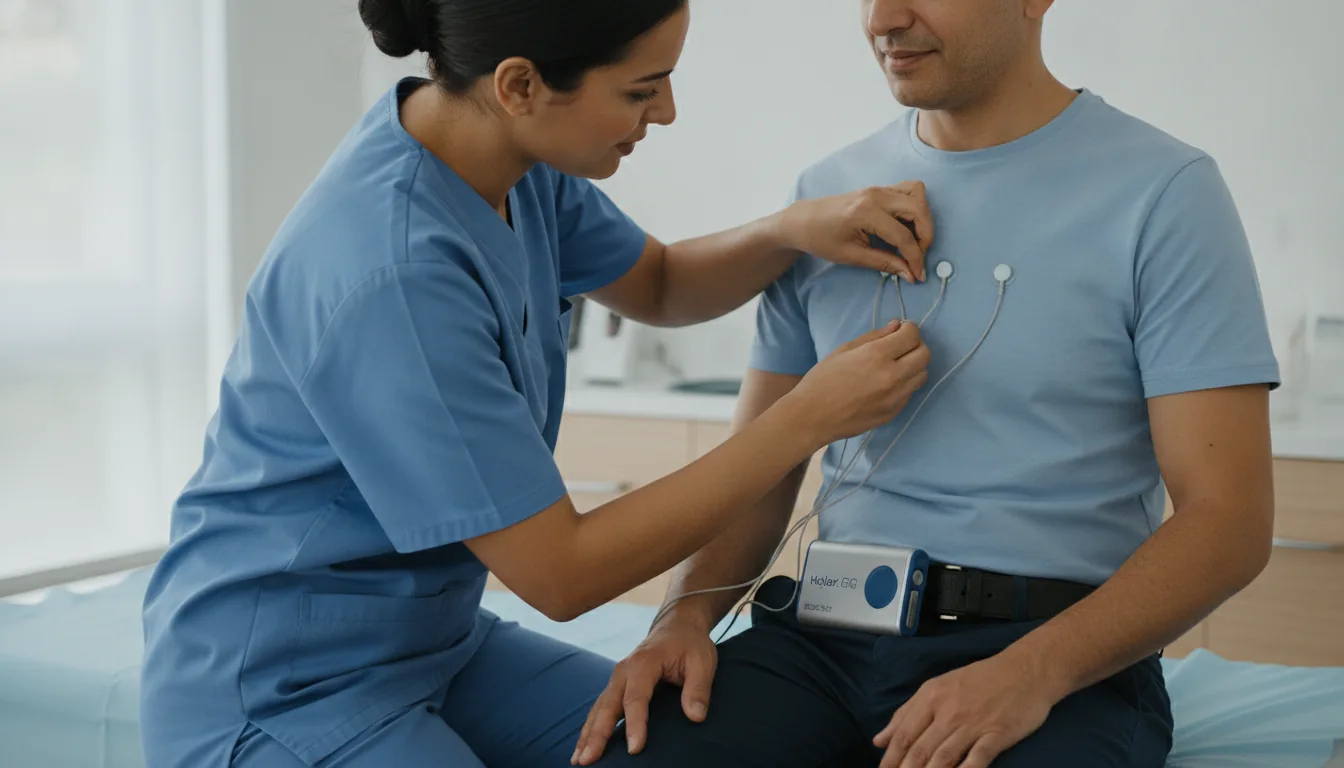
Holter ECG (continuous 24h-48h-72h recording)
Continuous recording of the heart's electrical activity over 24 to 72 hours using a small portable device, to detect intermittent rhythm abnormalities.
What is it?
When is it indicated?
When the heart races in unpredictable episodes, a standard ECG lasting a few seconds may show nothing: the Holter records continuously to capture these moments.
After fainting spells or episodes of faintness with no known cause, prolonged recording looks for a temporary slowing or racing of the heart.
The device observes how your heart beats throughout the day and night, at rest and during activity, to check that it adapts normally.
When this rhythm disorder occurs in short-lived episodes, the Holter shows how often and at what times the episodes occur.
While on treatment for a rhythm disorder, the recording verifies that the abnormalities have indeed decreased and that the medication is doing its job.
After a procedure to eliminate an arrhythmia, the Holter confirms that the rhythm remains regular and that there is no recurrence.
If the heart seems to beat too slowly or to pause, continuous recording precisely measures these slowdowns to decide on the appropriate course of action.
Palpitations or shortness of breath occurring at night are difficult to observe during a consultation: the Holter monitors the heart during sleep.
Preparation
Procedure
The technician prepares the skin of the chest (shaving if necessary, cleaning)
5 to 7 adhesive electrodes are placed on the chest
The electrodes are connected by cables to a small recording device
The device is attached to the belt or worn on a shoulder strap
The patient receives a diary to note their activities and symptoms
The patient goes home and resumes their usual activities
After 24h, 48h or 72h, the patient returns to the clinic to have the device removed
The data is transferred to a computer for analysis
Duration
24 to 72 hours of recording; fitting and removal: 15 minutes each
Results
Holter analysis takes 24 to 48 hours. Results are sent to the prescribing cardiologist or given to the patient at a follow-up consultation.
Risks and side effects
These risks remain rare. Your physician will inform you in detail before the examination.
Book an Appointment
Contact us to schedule your examination or request a quote.
Request a Quote +216 36 402 000