
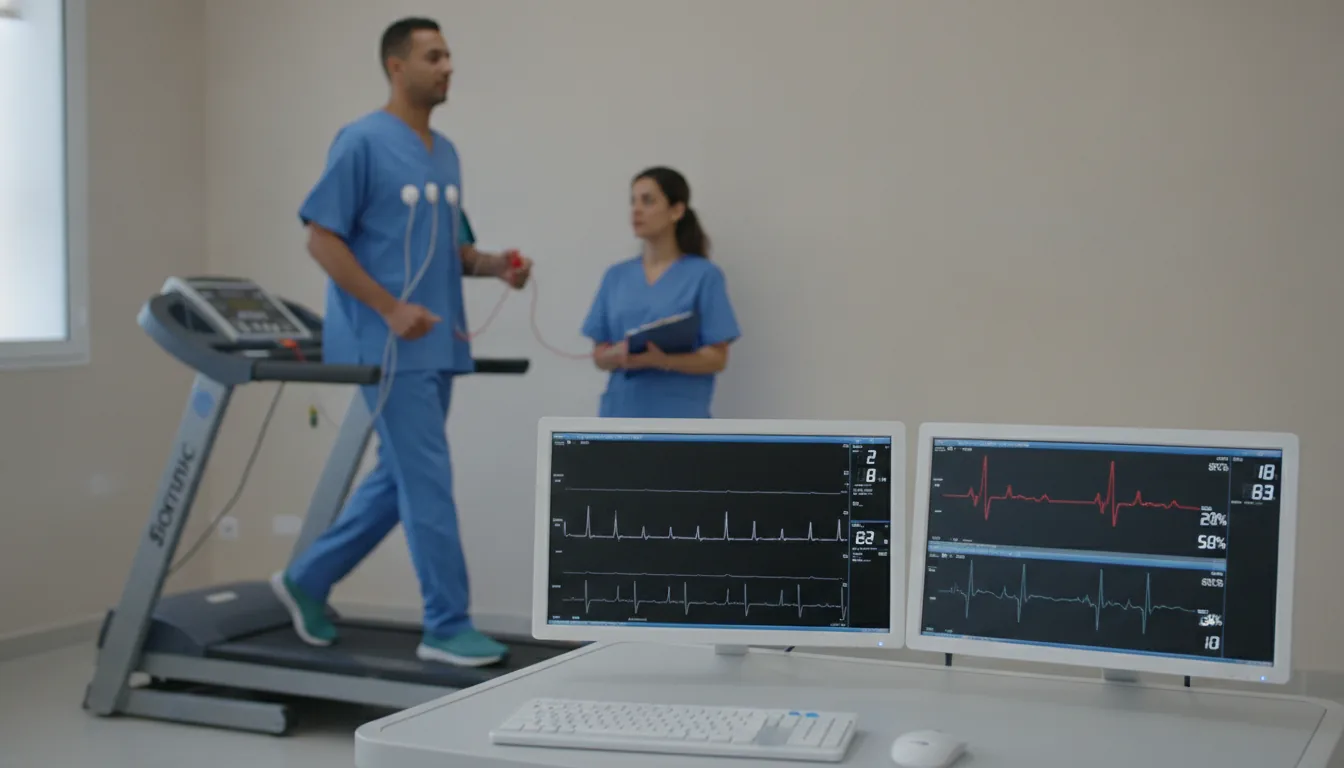
Treadmill stress test with monitoring

Treadmill stress test with monitoring

Comprehensive stress test with continuous monitoring of the ECG, blood pressure and oxygen saturation, to assess functional capacity and detect myocardial ischemia.

What is it?

The treadmill stress test with full monitoring is a reference cardiology examination that assesses the response of the cardiovascular system to progressive, controlled physical exercise. Unlike a simple exercise ECG, this examination includes continuous multi-parameter monitoring comprising the 12-lead ECG, blood pressure, oxygen saturation and sometimes the measurement of gas exchange. This examination is fundamental for assessing the patient's functional capacity, expressed in METs (metabolic equivalents). This figure is a major prognostic indicator in cardiology, because poor exercise capacity is associated with increased cardiovascular risk. The stress test also determines the ischemic threshold, that is, the level of exertion at which the heart begins to show signs of strain. Beyond the diagnosis of coronary artery disease, the stress test is used to assess chronotropic competence (the heart's ability to speed up normally during exercise), to detect exercise-induced rhythm disturbances, to measure the blood pressure response to exercise and to guide the prescription of a cardiac rehabilitation program. At the Clinique Pasteur in Tunis, stress tests are performed according to standardized international protocols with state-of-the-art monitoring equipment. A cardiologist is present throughout the examination, and full resuscitation equipment is immediately available.
Treadmill stress test with monitoring

When is it prescribed?

Diagnosis of coronary artery disease

By working the heart progressively under supervision, the test reveals a shortage of blood supply to the heart muscle that would remain invisible at rest.

Assessment of functional capacity (in METs)

The test precisely measures the level of exertion you can achieve, very useful information for the doctor to assess your cardiac fitness and track your progress.

Assessment after acute coronary syndrome

After a heart attack or cardiac alert, this supervised test checks the heart's recovery and helps organize the next steps of care.

Prescription of cardiac rehabilitation

Before starting a heart rehabilitation program, the test determines the appropriate, safe level of exercise for each patient.

Assessment of chronotropic competence

The examination checks that the heart speeds up normally as exercise increases; a heart that does not accelerate enough can explain fatigue and breathlessness.

Search for exercise-induced rhythm disturbances

Some irregular heartbeats only appear during exercise: the test triggers them in a safe setting so they can be recorded and analyzed.

Assessment of exertional breathlessness

When abnormal shortness of breath occurs during exercise, the test helps determine whether it comes from the heart, physical condition or another cause.

Assessment of the blood pressure response to exercise

The examination observes how blood pressure changes during exercise, because an excessive rise or an abnormal drop is important information for the doctor.

Sports fitness in cardiac patients

For a cardiac patient wishing to engage in physical activity, the test confirms that the intended sport is compatible with their state of health.

Preparation

1Fast for at least 3 hours (a light breakfast is tolerated)
2Wear comfortable sports clothing and sports shoes
3Do not smoke in the 3 hours before the examination
4Bring a complete list of your medications
5Some medications (beta-blockers, calcium channel blockers) may need to be stopped temporarily
6Avoid any intense physical exertion in the 12 hours before the examination
7Report any physical limitation (joint problems, respiratory failure)

How the exam is performed

1

Placement of the 12-lead ECG electrodes on the chest

2

Fitting of the blood pressure cuff and the oxygen saturation sensor

3

Recording of the ECG and blood pressure at rest

4

The patient starts walking slowly on the treadmill

5

The speed and incline are increased progressively according to the chosen protocol

6

The ECG, blood pressure and saturation are monitored continuously on screen

7

The cardiologist continuously assesses symptoms and the measured parameters

8

Exercise continues until the theoretical maximum heart rate, exhaustion or the appearance of stopping criteria

9

Active then passive recovery phase of 6 to 10 minutes

10

Full analysis of all the recorded parameters

Duration

45 minutes to 1 hour (including preparation, exercise and recovery)

Results

Results are communicated by the cardiologist immediately after the examination. A full report including the hemodynamic parameters, the ECG tracings and the interpretation is given to the patient.

Risks and side effects

Muscle fatigue and shortness of breath (normal and expected)
Chest pain (leads to stopping the test and immediate management)
Heart rhythm disturbance (rare, monitored continuously)
Low blood pressure during exercise or recovery (uncommon)
Fall on the treadmill (prevented by the support bars)
Serious cardiac event (exceptional, less than 1/10 000)

These risks remain rare. Your physician will explain them in detail before the exam.

Book an Appointment

Contact us to schedule your Stress test or request a quote.

Request a Quote +216 36 402 000

At a glance

Duration: 45 minutes to 1 hour (including preparation, exercise and recovery)
Preparation: Required
Book an appointment