
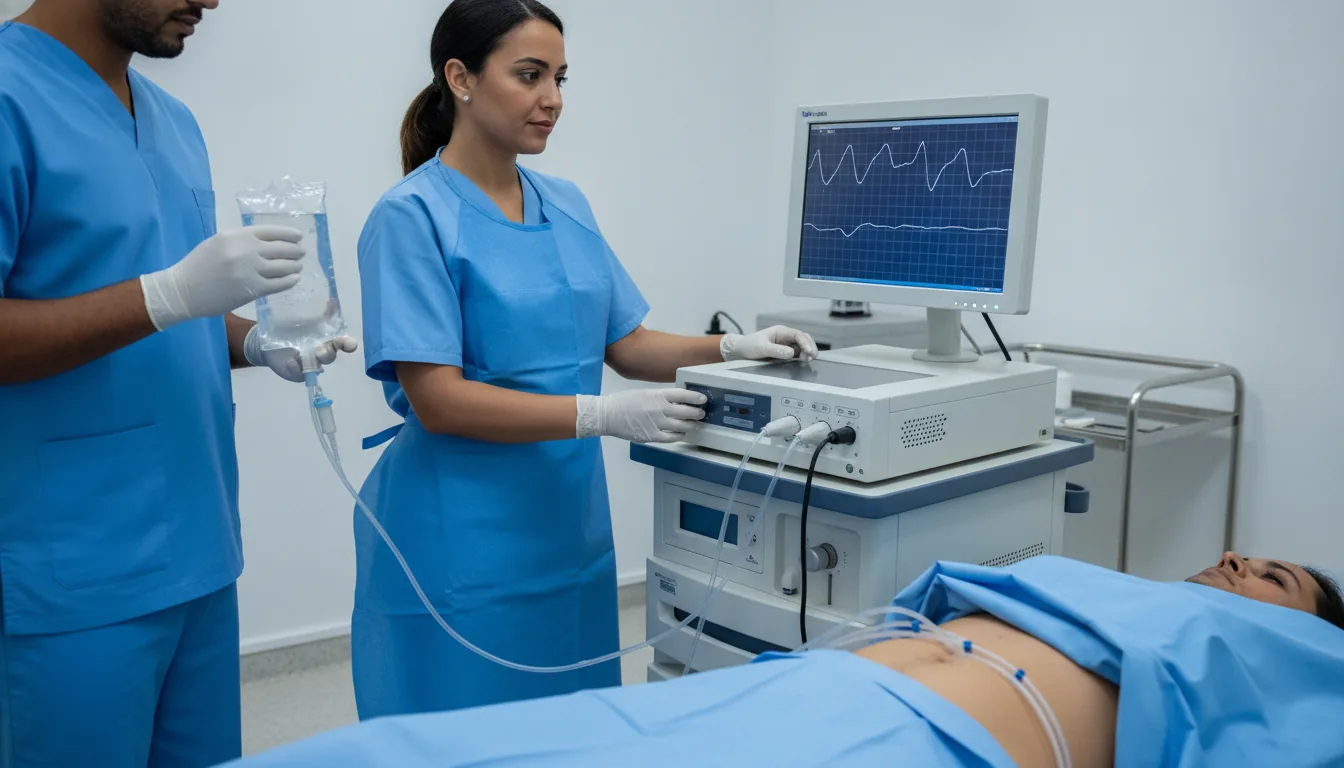
Bladder filling test
Assessment of bladder capacity and sensation by controlled filling, with analysis of compliance and detection of involuntary contractions.
What is it?
When is it indicated?
It helps investigate pressing and frequent urges to urinate by observing the behaviour of the bladder as it fills.
It can identify a bladder that has become stiff and distends poorly as it fills.
It helps assess whether the way the bladder functions puts the kidneys at risk in neurological patients.
It is useful when the perception of the need to urinate is reduced or, on the contrary, exaggerated.
It helps prepare a treatment for an overactive bladder by clarifying its behaviour during filling.
It is offered when a person urinates too often without an obvious cause, to explore the bladder.
It helps evaluate a painful, low-capacity bladder to guide management.
Preparation
Procedure
Comfortable installation in a semi-seated or gynaecological position
Measurement of the initial post-void residual
Insertion of a fine dual-channel bladder catheter and a rectal sensor
Gradual filling of the bladder at a controlled rate with warm saline solution
The patient reports their sensations: first desire, normal desire, urgent desire, compelling desire to void
Continuous recording of pressures and detection of uninhibited contractions
End of filling at the compelling desire to void or at maximum bladder capacity
Removal of the catheters
Duration
20 to 30 minutes
Results
The analysis covers maximum bladder capacity, compliance (volume/pressure ratio), sensation (volumes at the different levels of the desire to void) and detrusor stability (presence or absence of involuntary contractions). The report is available within 48 hours.
Risks and side effects
These risks remain rare. Your physician will inform you in detail before the examination.
Book an Appointment
Contact us to schedule your examination or request a quote.
Request a Quote +216 36 402 000