
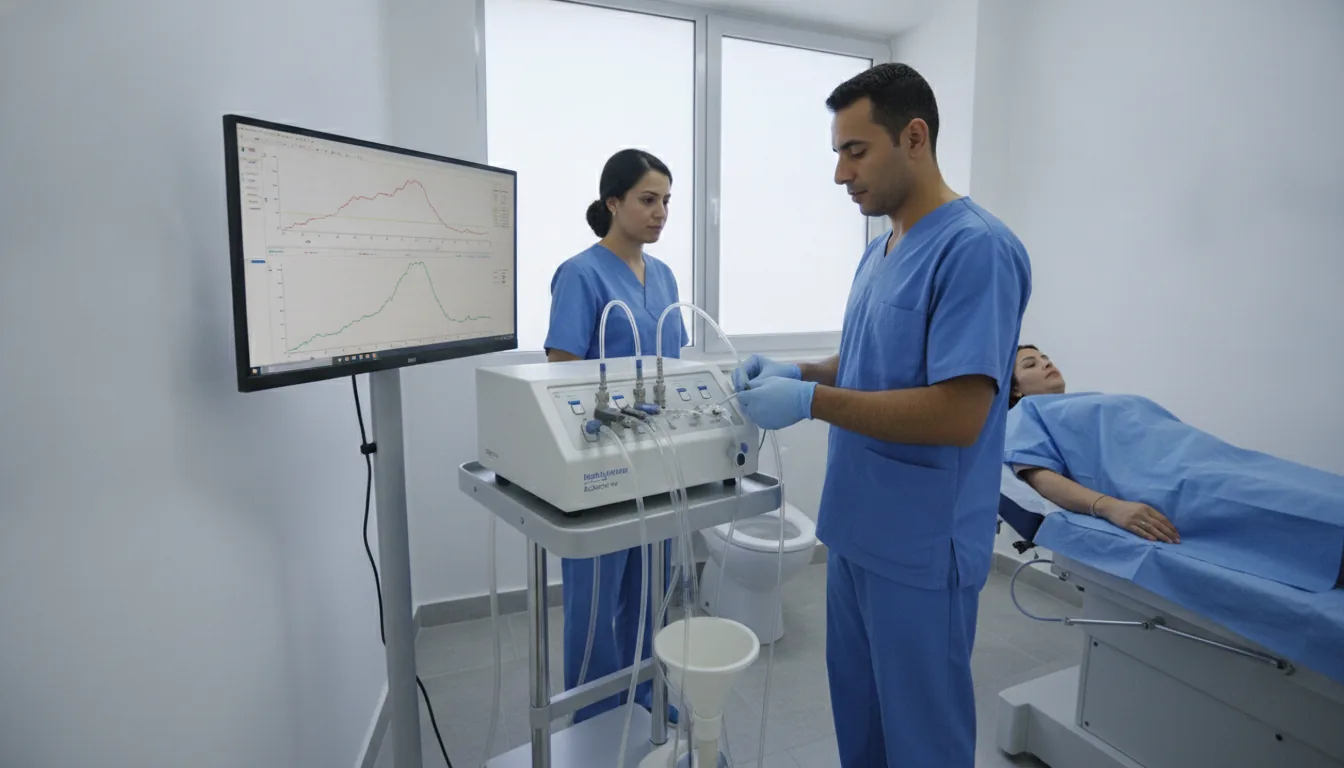
Pressure-flow study

Pressure-flow study

Simultaneous analysis of bladder pressure and urinary flow during voiding, essential for distinguishing obstruction from underactivity.

What is it?

The pressure-flow study is a fundamental urodynamic test that combines the simultaneous measurement of intravesical pressure and urinary flow during the voiding phase. It is the reference test for diagnosing bladder outlet obstruction. The principle is based on the relationship between the pressure generated by the detrusor muscle to expel urine and the resulting flow. In the case of obstruction (prostatic hyperplasia, urethral stricture), detrusor pressure is high but flow remains low. In the case of detrusor underactivity, both pressure and flow are reduced. The results are generally plotted on a nomogram (Abrams-Griffiths or Schäfer diagram) that classifies the patient into one of three categories: obstructed, equivocal or unobstructed. This classification is essential for treatment decisions, particularly in men with lower urinary tract symptoms. The pressure-flow study is particularly indicated before any prostatic deobstruction surgery, as it objectively confirms the obstruction and avoids unnecessary operations in patients whose symptoms are due to detrusor underactivity.
Pressure-flow study

When is it indicated?

Suspected bladder outlet obstruction (prostatic hyperplasia)

It helps confirm that an obstacle, often related to the prostate, is hindering the flow of urine.

Pre-operative assessment before adenomectomy or prostate resection

It is performed before a prostate operation to make sure it will bring a real benefit.

Differentiation between obstruction and detrusor underactivity

It helps determine whether difficulty urinating comes from an obstacle or from a bladder that does not contract enough.

Recurrent urethral stricture

It is useful when a narrowing of the urinary channel recurs, to assess its impact.

Evaluation after failure of medical treatment for voiding disorders

It is offered when medication has not been enough to improve difficulty urinating.

Dysuria of uncertain aetiology

It helps clarify the origin of difficulty urinating whose cause has not yet been established.

Preparation

1Recent negative urine culture (less than 7 days old)
2Arrive with a full bladder (drink enough before the test)
3Stop alpha-blockers 48 hours beforehand (on medical advice)
4Bring the results of previous tests (ultrasound, uroflowmetry)
5Report any history of urinary retention

Procedure

1

Insertion of a fine dual-channel bladder catheter

2

Placement of a rectal pressure sensor

3

Filling of the bladder until a comfortable desire to void is reached

4

The patient urinates with the sensors in place into a flowmeter

5

Simultaneous recording of bladder pressure, abdominal pressure and flow

6

Calculation of the detrusor pressure (bladder pressure minus abdominal pressure)

7

Removal of the catheters after voiding

Duration

30 to 45 minutes

Results

The results are plotted on a nomogram (Abrams-Griffiths or Schäfer) that classifies the patient as obstructed, equivocal or unobstructed. The detrusor pressure at maximum flow (PdetQmax) is the key parameter. The detailed report is available within 48 hours.

Risks and side effects

Discomfort from the bladder catheter in place during voiding
Possible difficulty urinating with the catheter (stress, discomfort)
Low risk of urinary tract infection
Transient burning on urination after the test

These risks remain rare. Your physician will inform you in detail before the examination.

Book an Appointment

Contact us to schedule your examination or request a quote.

Request a Quote +216 36 402 000

At a glance

Duration: 30 to 45 minutes
Preparation: Required
Book an appointment