
Urinary incontinence assessment
Centres/Urodynamic Testing/Incontinence assessment

Urinary incontinence assessment

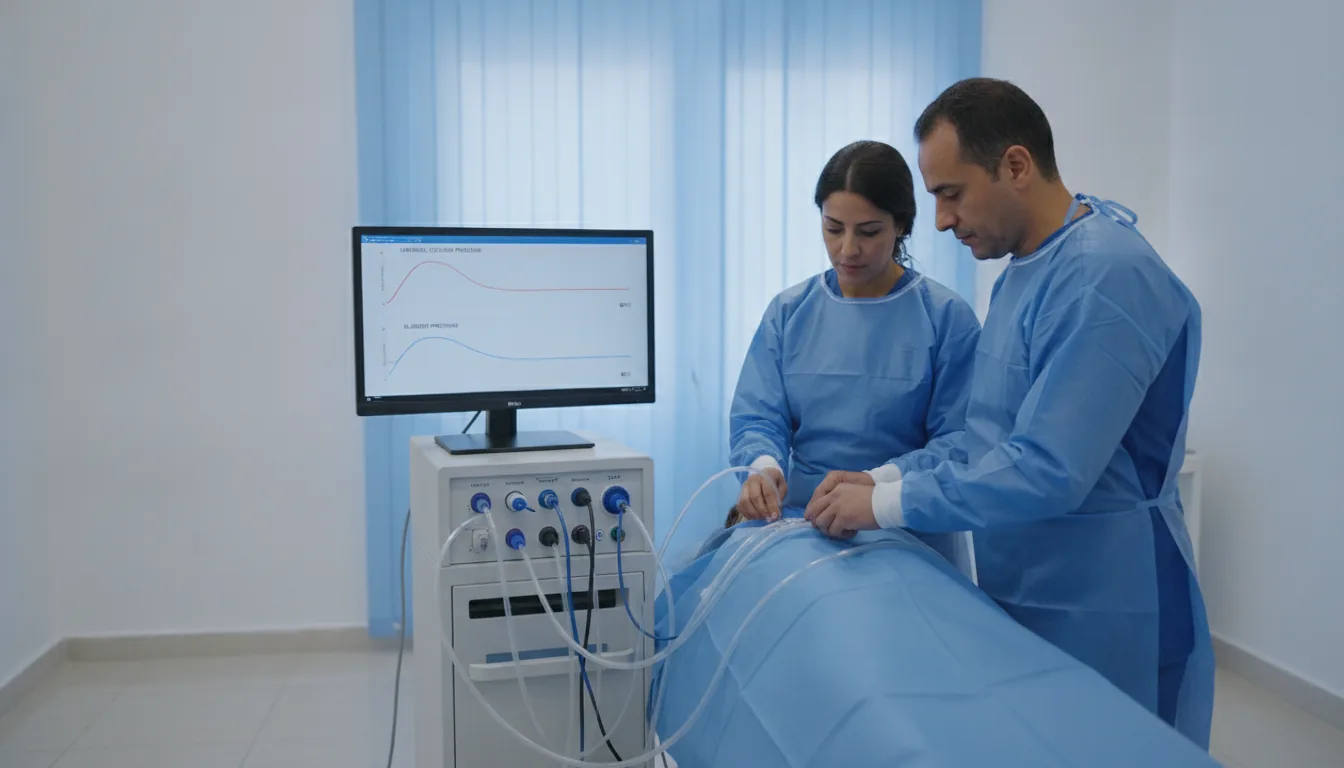
Complete, targeted urodynamic exploration to characterise the type of urinary incontinence and guide therapeutic management.

What is it?

The urinary incontinence assessment is a urodynamic exploration specifically directed at the aetiological diagnosis and characterisation of urinary leakage. It aims to determine the mechanism of the incontinence (stress, urgency, mixed) and to quantify its severity in order to guide the treatment strategy. Stress urinary incontinence is due to a failure of the urethral closure mechanisms during rises in abdominal pressure. The assessment then includes urethral profilometry to measure the closure pressure, and a stress leak test (Valsalva test or cough test with a full bladder) to reproduce and quantify the leakage. Urgency incontinence (or overactive bladder incontinence) is caused by involuntary contractions of the detrusor. Filling cystometry can reveal these uninhibited contractions, measure their amplitude and correlate them with the symptoms reported by the patient. The detection of detrusor overactivity profoundly changes the therapeutic approach. Mixed incontinence, combining a stress component and an urgency component, is common and requires a complete assessment to rank the two components. Treatment of the predominant component will be given priority as first-line management. The incontinence assessment also includes a pad test (pad weighing test) to objectively quantify the leakage over a given period.
Urinary incontinence assessment

When is it indicated?

Stress urinary incontinence in women

It helps explain leakage that occurs during effort, coughing or laughing, which is common in women.

Urinary incontinence after radical prostatectomy in men

It is useful for investigating urinary leakage that has appeared after a prostate operation.

Urgency incontinence resistant to medical treatment

It is offered when pressing urges with leakage persist despite medication.

Mixed incontinence requiring ranking of the components

When several types of leakage coexist, it helps determine which one to treat first.

Pre-operative assessment before incontinence surgery

It is one of the tests preparing for an operation for urinary leakage, in order to optimise its result.

Recurrent incontinence after surgical repair

It is useful when leakage reappears after an operation, to understand its cause.

Incontinence in the elderly requiring a precise evaluation

It helps clarify the mechanism of leakage in the elderly in order to adapt management.

Preparation

1Sterile urine culture less than 7 days old
2Complete a voiding diary over 3 days before the test
3Stop anticholinergics and beta-3 agonists 48 hours beforehand
4Arrive with a comfortably full bladder
5Bring the results of the pad test if performed
6Wear comfortable clothing that is easy to remove

Procedure

1

Detailed questioning about the type of leakage and its impact

2

Free uroflowmetry and measurement of the post-void residual

3

Insertion of the bladder catheter and the rectal sensor

4

Filling cystometry with a search for involuntary contractions

5

Stress leak test: coughing and Valsalva at different filling volumes

6

Urethral profilometry at rest and during effort

7

Short pad test if necessary (1 hour with standardised activities)

8

Removal of the catheters and personalised advice

Duration

30 to 45 minutes (up to 1 hour 30 with the pad test)

Results

The assessment classifies the incontinence into three types: stress incontinence (sphincter deficiency or urethral hypermobility), urgency incontinence (detrusor overactivity) or mixed incontinence. The severity is quantified by the leak point pressure, the closure pressure and the pad test. The detailed report guides therapeutic management.

Risks and side effects

Discomfort related to the catheter and the manoeuvres used to provoke leakage
Urine leakage expected during the test (that is the objective)
Low risk of urinary tract infection
Transient burning on urination
Psychologically sensitive aspect: the test is performed with tact and discretion

These risks remain rare. Your physician will inform you in detail before the examination.

Book an Appointment

Contact us to schedule your examination or request a quote.

Request a Quote +216 36 402 000

At a glance

Duration: 30 to 45 minutes (up to 1 hour 30 with the pad test)
Preparation: Required
Book an appointment